
Stomatology ›› 2026, Vol. 46 ›› Issue (6): 409-415.doi: 10.13591/j.cnki.kqyx.2026.06.002
• Basic and Clinical Research • Previous Articles Next Articles
LIANG Xiaolun, ZHANG Menghan, ZHANG Wenzhe, WU Mengjie( )
)
Received:2025-10-02
Online:2026-06-28
Published:2026-06-17
CLC Number:
LIANG Xiaolun, ZHANG Menghan, ZHANG Wenzhe, WU Mengjie. Three-dimensional finite element analysis of the effect of clear aligner thickness and attachments on the efficiency of canine distalization[J]. Stomatology, 2026, 46(6): 409-415.
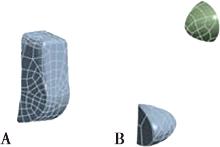
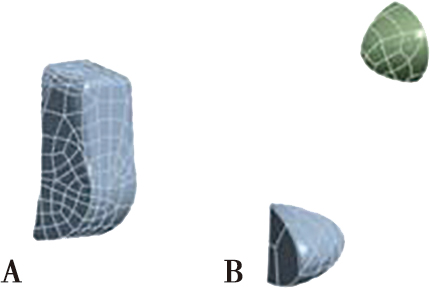
Fig.1
Attachment model"
Tab.1
Material properties"
| 材料 | 弹性模量/MPa | 泊松比 |
|---|---|---|
| 牙周膜 | 0.69 | 0.45 |
| 牙体 | 1.96×10⁴ | 0.30 |
| 牙槽骨 | 1.37×10³ | 0.30 |
| 隐形矫治器 | 5.28×10² | 0.36 |
| 附件 | 1.25×10⁴ | 0.36 |
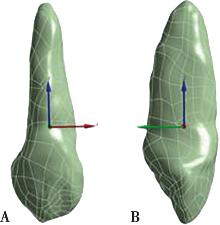
Fig.2
Canine coordinate system"
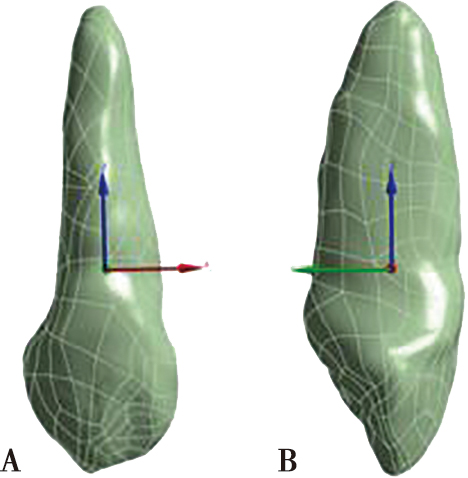
Fig.3
von Mises stress distribution in canine tooth structure"
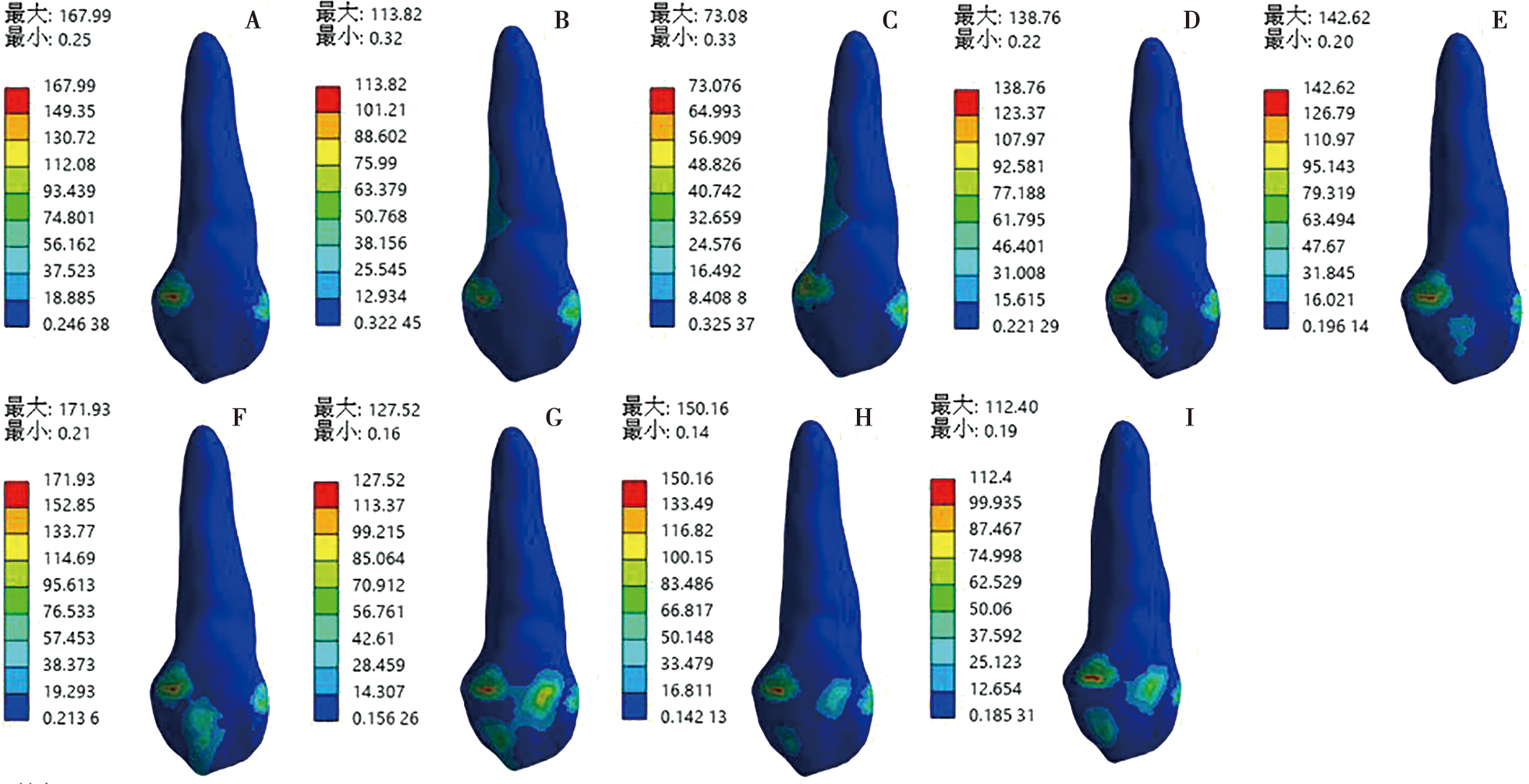
Fig.4
Maximum principal stress distribution in canine tooth structure"
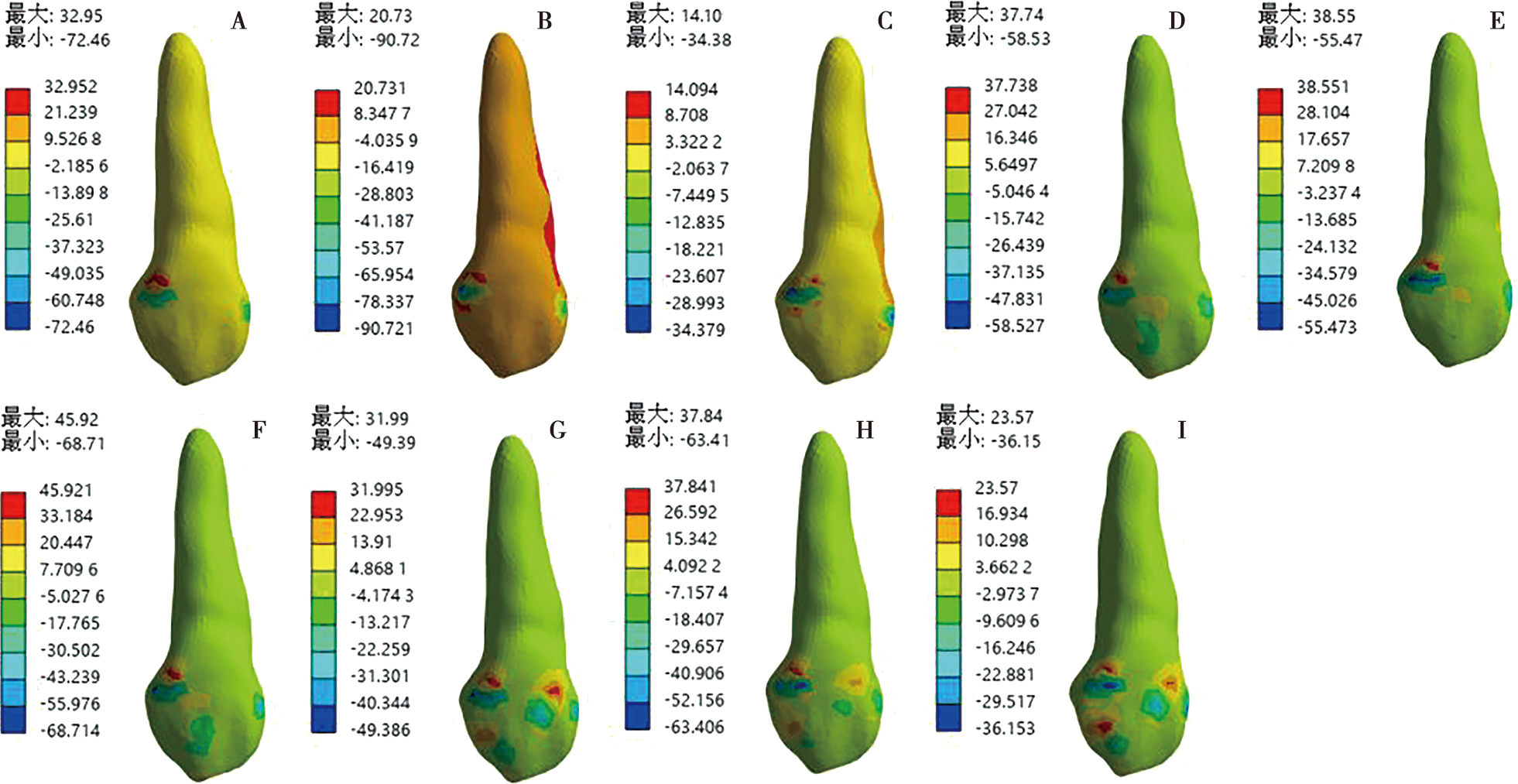
Fig.5
von Mises stress distribution in canine periodontal ligament"
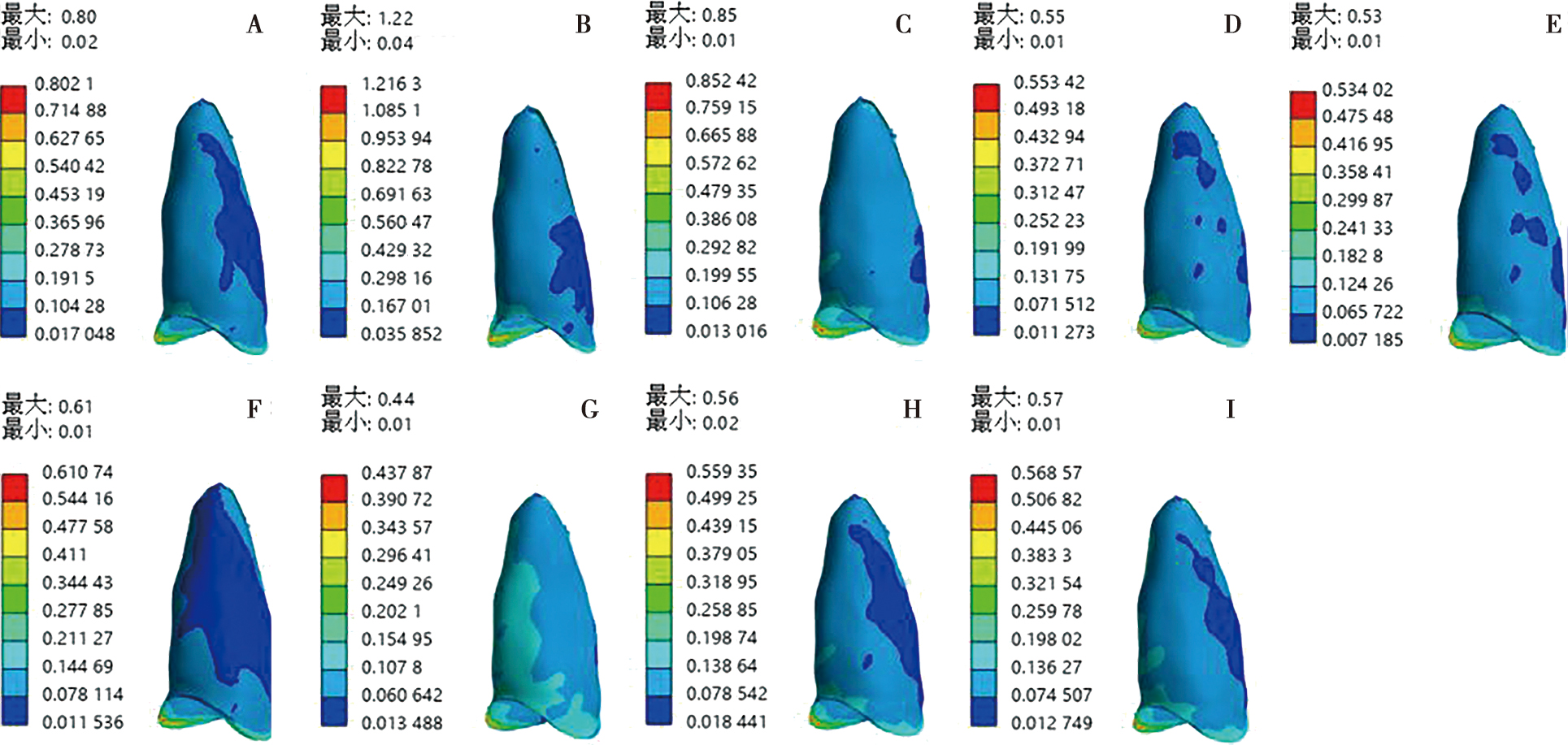
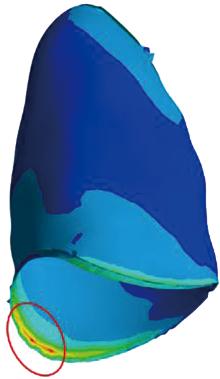
Fig.6
von Mises maximum stress distribution in the canine periodontal ligament"
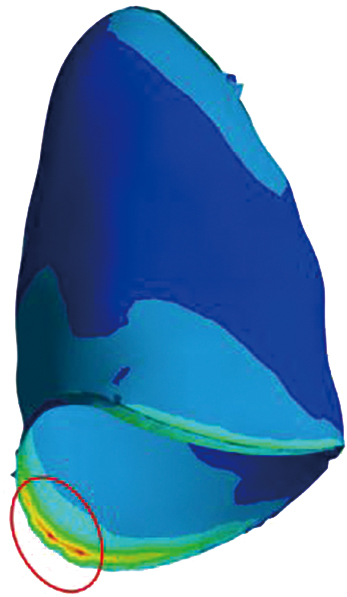
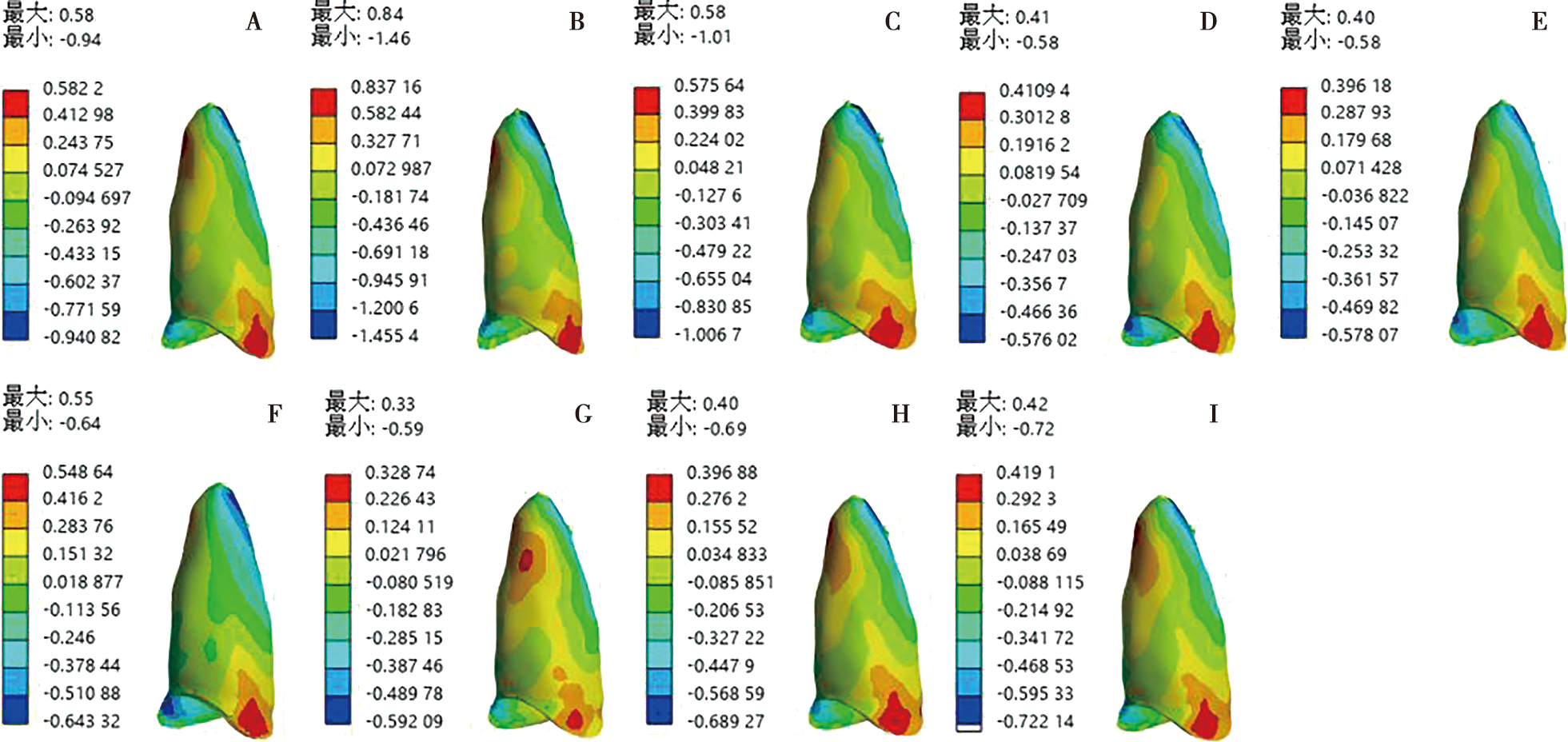
Fig.7
Maximum principal stress distribution in canine periodontal ligament"
Tab.2
Displacements in X-axis direction mm"
| 分组 | 牙尖点 | 根尖点 | 近中点 | 远中点 |
|---|---|---|---|---|
| 0.70 mm无附件 | -0.234 | -0.013 | -0.219 | -0.168 |
| 0.75 mm无附件 | -0.235 | 0.054 | -0.217 | -0.162 |
| 0.80 mm无附件 | -0.210 | 0.003 | -0.198 | -0.148 |
| 0.70 mm垂直矩形附件 | -0.218 | -0.047 | -0.208 | -0.169 |
| 0.75 mm垂直矩形附件 | -0.245 | -0.018 | -0.224 | -0.180 |
| 0.80 mm垂直矩形附件 | -0.208 | -0.035 | -0.194 | -0.156 |
| 0.70 mm控根附件 | -0.199 | -0.093 | -0.194 | -0.170 |
| 0.75 mm控根附件 | -0.212 | -0.060 | -0.201 | -0.167 |
| 0.80 mm控根附件 | -0.209 | -0.057 | -0.198 | -0.164 |
Tab.3
Displacements in Y-axis direction mm"
| 分组 | 牙尖点 | 根尖点 | 近中点 | 远中点 |
|---|---|---|---|---|
| 0.70 mm无附件 | 0.052 | 0.145 | 0.028 | 0.120 |
| 0.75 mm无附件 | 0.059 | 0.186 | 0.033 | 0.131 |
| 0.80 mm无附件 | 0.062 | 0.132 | 0.032 | 0.124 |
| 0.70 mm垂直矩形附件 | 0.063 | 0.090 | 0.037 | 0.108 |
| 0.75 mm垂直矩形附件 | 0.044 | 0.082 | 0.023 | 0.084 |
| 0.80 mm垂直矩形附件 | 0.067 | 0.097 | 0.044 | 0.107 |
| 0.70 mm控根附件 | 0.066 | 0.115 | 0.050 | 0.111 |
| 0.75 mm控根附件 | 0.055 | 0.129 | 0.034 | 0.104 |
| 0.80 mm控根附件 | 0.065 | 0.141 | 0.044 | 0.114 |
Tab.4
Displacements in Z-axis direction mm"
| 分组 | 牙尖点 | 根尖点 | 近中点 | 远中点 |
|---|---|---|---|---|
| 0.70 mm无附件 | 0.175 | 0.164 | 0.134 | 0.206 |
| 0.75 mm无附件 | 0.230 | 0.219 | 0.179 | 0.275 |
| 0.80 mm无附件 | 0.211 | 0.203 | 0.175 | 0.246 |
| 0.70 mm垂直矩形附件 | 0.122 | 0.120 | 0.094 | 0.150 |
| 0.75 mm垂直矩形附件 | 0.091 | 0.084 | 0.050 | 0.129 |
| 0.80 mm垂直矩形附件 | 0.125 | 0.112 | 0.092 | 0.148 |
| 0.70 mm控根附件 | 0.134 | 0.131 | 0.118 | 0.150 |
| 0.75 mm控根附件 | 0.128 | 0.121 | 0.101 | 0.147 |
| 0.80 mm控根附件 | 0.137 | 0.131 | 0.111 | 0.157 |
| [1] |
Kravitz ND, Kusnoto B, BeGole E, et al. How well does Invisalign work? A prospective clinical study evaluating the efficacy of tooth movement with Invisalign[J]. Am J Orthod Dentofac Orthop, 2009, 135(1): 27-35.
doi: 10.1016/j.ajodo.2007.05.018 |
| [2] | 马晓晴, 项飞, 樊明月, 等. 微种植钉辅助无托槽隐形矫治器控制“过山车”效应的疗效分析[J]. 上海口腔医学, 2022, 31(2):193-197. |
| [3] | 徐小红, 张阳, 张梦男, 等. 成年拔牙患者隐形矫治牙齿移动效率的三维测量分析[J]. 口腔生物医学, 2021, 12(4):252-256. |
| [4] |
Xia Q, He Y, Jia LR, et al. Assessment of labially impacted canines traction mode with clear aligners vs. fixed appliance: A comparative study based on 3D finite element analysis[J]. Front Bioeng Biotechnol, 2022, 10: 1004223.
doi: 10.3389/fbioe.2022.1004223 |
| [5] |
Hong K, Kim WH, Eghan-Acquah E, et al. Efficient design of a clear aligner attachment to induce bodily tooth movement in orthodontic treatment using finite element analysis[J]. Materials, 2021, 14(17): 4926.
doi: 10.3390/ma14174926 |
| [6] |
Liu L, Song QX, Zhou J, et al. The effects of aligner overtreat-ment on torque control and intrusion of incisors for anterior retraction with clear aligners: A finite-element study[J]. Am J Orthod Dentofac Orthop, 2022, 162(1): 33-41.
doi: 10.1016/j.ajodo.2021.02.020 |
| [7] |
Cheng YX, Liu XL, Chen X, et al. The three-dimensional displacement tendency of teeth depending on incisor torque compensation with clear aligners of different thicknesses in cases of extraction: A finite element study[J]. BMC Oral Health, 2022, 22(1): 499.
doi: 10.1186/s12903-022-02521-7 pmid: 36384512 |
| [8] |
Nucera R, Dolci C, Bellocchio AM, et al. Effects of composite attachments on orthodontic clear aligners therapy: A systematic review[J]. Materials, 2022, 15(2): 533.
doi: 10.3390/ma15020533 |
| [9] | Luu B, Cronauer EA, Gandhi V, et al. A finite element approach for locating the center of resistance of maxillary teeth[J]. JoVE, 2020, 158: e60746. |
| [10] |
Yoshida N, Koga Y, Peng CL, et al. Measurement of the elastic modulus of the human periodontal ligament[J]. Med Eng Phys, 2001, 23(8): 567-572.
pmid: 11719079 |
| [11] | 张宁, 白玉兴, 张昆亚, 等. 不同厚度热压膜材料的力学性能研究[J]. 北京口腔医学, 2009, 17(4):184-186. |
| [12] | 邢锐. 不同厚度无托槽隐形矫治器矫治应变力学效果研究[J]. 中国医药科学, 2014, 4(23):167-169. |
| [13] | 吴晓君, 曾裕文, 熊国平. 无托槽矫治伴牙槽骨吸收倾斜上切牙的有限元分析及最佳矫治器厚度探讨[J]. 临床口腔医学杂志, 2021, 37(10):583-586. |
| [14] |
Seo JH, Eghan-Acquah E, Kim MS, et al. Comparative analysis of stress in the periodontal ligament and center of rotation in the tooth after orthodontic treatment depending on clear aligner thickness: Finite element analysis study[J]. Materials, 2021, 14(2): 324.
doi: 10.3390/ma14020324 |
| [15] |
Liu L, Zhan Q, Zhou J, et al. Effectiveness of an anterior mini-screw in achieving incisor intrusion and palatal root torque for anterior retraction with clear aligners[J]. Angle Orthod, 2021, 91(6): 794-803.
doi: 10.2319/120420-982.1 pmid: 34061964 |
| [16] |
Jiang T, Wu RY, Wang JK, et al. Clear aligners for maxillary anterior en masse retraction: A 3D finite element study[J]. Sci Rep, 2020, 10: 10156.
doi: 10.1038/s41598-020-67273-2 pmid: 32576935 |
| [17] |
Li YX, Xiao SZ, Jin Y, et al. Stress and movement trend of lower incisors with different IMPA intruded by clear aligner: A three-dimensional finite element analysis[J]. Prog Orthod, 2023, 24(1): 5.
doi: 10.1186/s40510-023-00454-7 pmid: 36775824 |
| [18] | 许诺. 无托槽隐形矫治器不同附件远移上颌尖牙的三维有限元分析[D]. 兰州: 兰州大学, 2018. |
| [19] | 程亚男, 于佳志, 刘印倡, 等. 不同厚度与边缘无托槽隐形矫治器推磨牙远移的三维有限元分析[J]. 中国组织工程研究, 2026, 30(2):310-318. |
| [20] | 曹熔锴, 陈孛蓓, 李琼, 等. 应用3D数字化面部重建评估上颌尖牙垂直位置对微笑美学的影响[J]. 上海口腔医学, 2020, 29(6):611-616. |
| [21] |
Sachdev S, Tantidhnazet S, Saengfai NN. Accuracy of tooth movement with in-house clear aligners[J]. J World Fed Orthod, 2021, 10(4): 177-182.
doi: 10.1016/j.ejwf.2021.08.003 pmid: 34625386 |
| [22] |
Haouili N, Kravitz ND, Vaid NR, et al. Has Invisalign improved? A prospective follow-up study on the efficacy of tooth movement with Invisalign[J]. Am J Orthod Dentofac Orthop, 2020, 158(3): 420-425.
doi: 10.1016/j.ajodo.2019.12.015 |
| [23] |
Giancotti A, Greco M, Mampieri G. Extraction treatment using Invisalign technique[J]. Prog Orthod, 2006, 7(1): 32-43.
pmid: 16552454 |
| [24] | Hartshorne J, Wertheimer MB. Emerging insights and new developments in clear aligner therapy: A review of the literature[J]. Clin Companion, 2022, 2(4): 311-324. |
| [25] | 杨斌, 白玉兴. 两种矫治技术治疗牙周病患者牙周组织应力的对比分析[J]. 现代口腔医学杂志, 2009, 23(3):232-234. |
| [26] | 方群智. 不同矫治器膜片参数对无托槽隐形矫治技术远中移动上颌尖牙影响的三维有限元分析[D]. 杭州: 浙江中医药大学, 2022. |
| [27] |
Gomez JP, Peña FM, Martínez V, et al. Initial force systems during bodily tooth movement with plastic aligners and composite attachments: A three-dimensional finite element analysis[J]. Angle Orthod, 2015, 85(3): 454-460.
doi: 10.2319/050714-330.1 pmid: 25181252 |
| [28] | 鞠博, 李德水, 刘盼盼, 等. 隐适美矫治器矩形附件与优化附件远移尖牙效率的对比研究[J]. 山东大学学报(医学版), 2019, 57(4):101-105. |
| Viewed | ||||||
|
Full text |
|
|||||
|
Abstract |
|
|||||
