
Stomatology ›› 2026, Vol. 46 ›› Issue (3): 215-223.doi: 10.13591/j.cnki.kqyx.2026.03.010
• Review • Previous Articles Next Articles
WANG Xiaoting1, WANG Yanwei1, LI Pengjin1, LI Tong1, LIU Yuping1, YUAN Jun2( )
)
Received:2025-04-30
Online:2026-03-28
Published:2026-03-31
CLC Number:
WANG Xiaoting, WANG Yanwei, LI Pengjin, LI Tong, LIU Yuping, YUAN Jun. Advances in immunomodulatory mechanisms and related applications of MXene nanomaterials[J]. Stomatology, 2026, 46(3): 215-223.
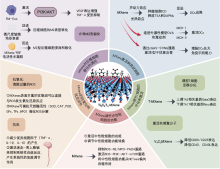
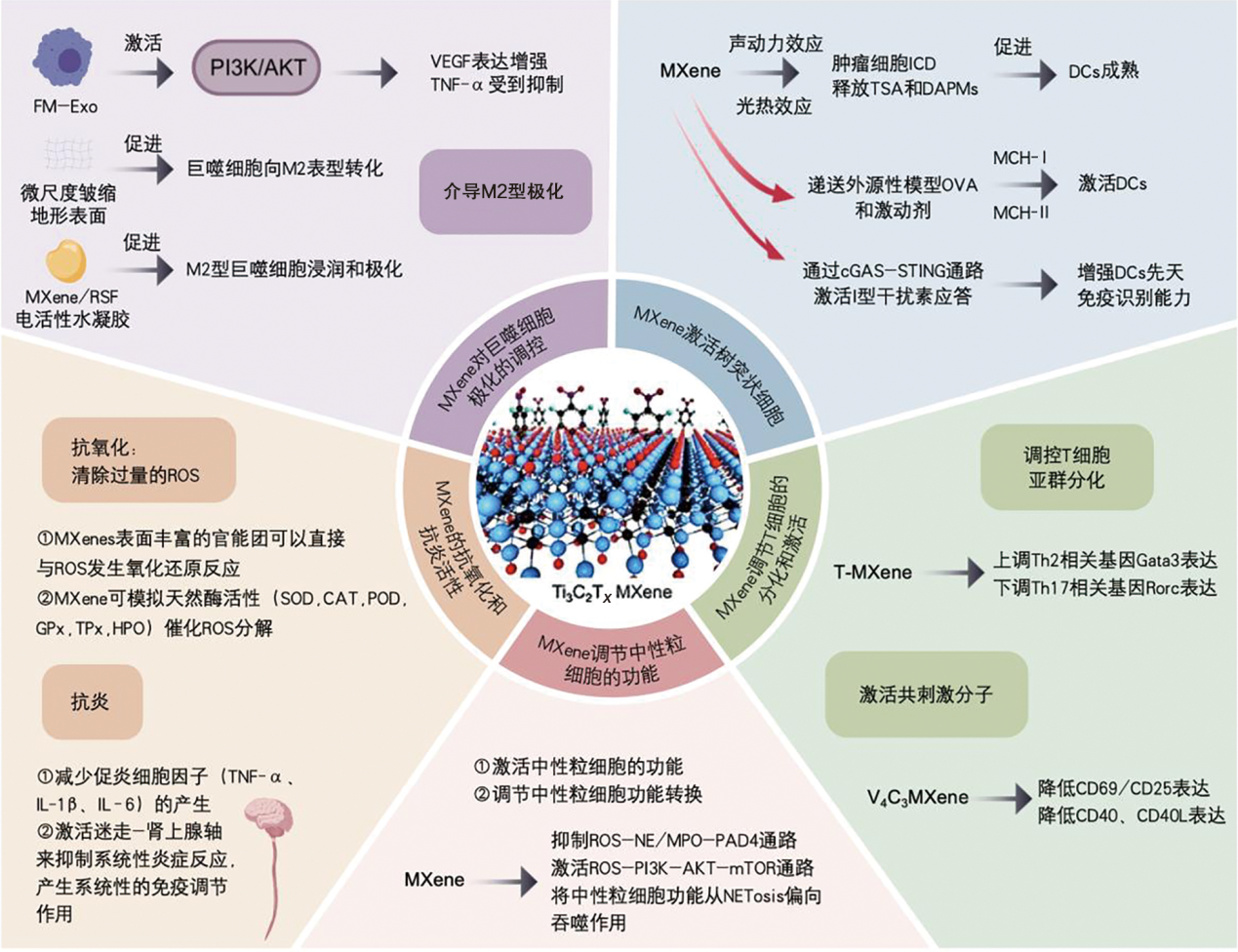
Fig.1
Schematic diagram of the immunomodulatory mechanism of MXene nanomaterials"
Tab.1
Immunomodulatory properties and mechanism of action of representative MXene nanomaterials"
| MXene类型 | 免疫调节特性 | 作用机制 | 参考文献 |
|---|---|---|---|
| Ti3C2Tx | 强抗氧化、抗炎;调控M2型巨噬细胞极化;激活DC成熟 | 清除ROS;下调NF-κB/MAPK通路;物理吸附细胞因子;降低促炎因子表达水平;光热诱导ICD | [ |
| Nb2CTx | 抗氧化 | 表面官能团的氧化还原反应 | [ |
| V2CTx | 抗氧化;调节中性粒细胞功能转换 | 强多酶模拟活性,催化ROS分解;抑制ROS-NE/MPO-PAD4通路,激活ROS-PI3K-AKT-mTOR通路 | [ |
| V4C3Tx | 免疫抑制;降低T细胞活化 | 下调CD40/CD40L表达;抑制TCR信号和抗原呈递;上调EIF2通路 | [ |
| Ti3C2 MQDs | 调节T细胞分化;激活中性粒细胞功能 | 选择性抑制IFN-γ+ Th1细胞;促进CD4+CD25+FoxP3+ Treg扩增;诱导中性粒细胞脱颗粒和NETosis | [ |
| Pd@Ti3-xC2Ty | 调控巨噬细胞极化;激活DC | 增强声动力效应;诱导TAMs向M1型转化 | [ |
| Bi2MoO6-MXene | 促进DC成熟 | 增强声动力效应诱导细胞铁死亡 | [ |
| [1] |
Naguib M, Kurtoglu M, Presser V, et al. Two-dimensional nanocrystals produced by exfoliation of Ti3 AlC2[J]. Adv Mater, 2011, 23(37): 4248-4253.
doi: 10.1002/adma.v23.37 |
| [2] |
Murali G, Reddy Modigunta JK, Park YH, et al. A review on MXene synthesis, stability, and photocatalytic applications[J]. ACS Nano, 2022, 16(9): 13370-13429.
doi: 10.1021/acsnano.2c04750 pmid: 36094932 |
| [3] | Xu X, Zhang Y, Sun H, et al. Progress and perspective: MXene and MXene-Based nanomaterials for high-performance energy storage devices[J]. Advanced Electronic Materials, 2021, 7(7): 2000967. |
| [4] | Peng GT, Fadeel B. Understanding the bidirectional interactions between two-dimensional materials, microorganisms, and the immune system[J]. Adv Drug Deliv Rev, 2022, 188: 114422. |
| [5] | Sun KY, Wu YZ, Xu J, et al. Niobium carbide (MXene) reduces UHMWPE particle-induced osteolysis[J]. Bioact Mater, 2021, 8: 435-448. |
| [6] | 郭宇昊, 李草. MXene在炎症相关疾病治疗领域的研究进展[J]. 胶体与聚合物, 2025, 43(3):138-142. |
| [7] | 赵禹, 张潇, 姚超凡, 等. MXene材料在生物医学应用中的研究进展[J/OL]. 材料工程, 2024: 1-13. (2024-12-17). https://kns.cnki.net/KCMS/detail/detail.aspxfilename=CLGC20241211001&dbname=CJFD&dbcode=CJFQ. |
| [8] |
Morris G, Gevezova M, Sarafian V, et al. Redox regulation of the immune response[J]. Cell Mol Immunol, 2022, 19(10): 1079-1101.
doi: 10.1038/s41423-022-00902-0 pmid: 36056148 |
| [9] | Zhou C, Zhao X, Xiong Y, et al. A review of etching methods of MXene and applications of MXene conductive hydrogels[J]. European Polymer Journal, 2022, 167. |
| [10] |
Zarepour A, Karasu Ç, Mir Y, et al. Graphene- and MXene-based materials for neuroscience: Diagnostic and therapeutic applications[J]. Biomaterials science, 2023, 11(20): 6687-6710.
doi: 10.1039/D3BM01114C |
| [11] |
Lin H, Wang X, Yu L, et al. Two-dimensional ultrathin MXene ceramic nanosheets for photothermal conversion[J]. Nano Lett, 2017, 17(1) :384-391.
doi: 10.1021/acs.nanolett.6b04339 pmid: 28026960 |
| [12] |
Zada S, Dai W, Kai Z, et al. Algae Extraction controllable delam-ination of vanadium carbide nanosheets with enhanced near-infrared photothermal performance[J]. Angew Chem Int Ed Engl, 2020, 59(16) :6601-6606.
doi: 10.1002/anie.v59.16 |
| [13] |
Wan S, Li X, Chen Y, et al. Ultrastrong MXene films via the synergy of intercalating small flakes and interfacial bridging[J]. Nat Commun, 2022, 13(1):7340.
doi: 10.1038/s41467-022-35226-0 |
| [14] |
Li Y, Fu RZ, Duan ZG, et al. Artificial nonenzymatic antioxidant MXene nanosheet-anchored injectable hydrogel as a mild photothermal-controlled oxygen release platform for diabetic wound healing[J]. ACS Nano, 2022, 16(5): 7486-7502.
doi: 10.1021/acsnano.1c10575 pmid: 35533294 |
| [15] |
Feng W, Han XG, Hu H, et al. 2D vanadium carbide MXenzyme to alleviate ROS-mediated inflammatory and neurodegenerative diseases[J]. Nat Commun, 2021, 12: 2203.
doi: 10.1038/s41467-021-22278-x pmid: 33850133 |
| [16] |
Unal MA, Bayrakdar F, Fusco L, et al. 2D MXenes with antiviral and immunomodulatory properties: A pilot study against SARS-CoV-2[J]. Nano Today, 2021, 38: 101136.
doi: 10.1016/j.nantod.2021.101136 |
| [17] | Zhang T, Ma C, Zhang ZQ, et al. NF-κB signaling in inflammation and cancer[J]. Med Comm (2020), 2021, 2(4): 618-653. |
| [18] |
Ren DW, Zhang Y, Du B, et al. An antibacterial, conductive nanocomposite hydrogel coupled with electrical stimulation for accelerated wound healing[J]. Int J Nanomedicine, 2024, 19: 4495-4513.
doi: 10.2147/IJN.S460700 |
| [19] | Sha BN, Zhao SZ, Gu ML, et al. Doping-induced assembly interface for noninvasive in vivo local and systemic immunomodulation[J]. Proc Natl Acad Sci U S A, 2023, 120(49): e2306777120. |
| [20] | 刘利萍, 张焱皓, 李茂, 等. 调控巨噬细胞极化的相关信号通路及其调节机制研究进展[J]. 中国免疫学杂志, 2021, 37(6): 747-753. |
| [21] | Pérez S, Rius-Pérez S. Macrophage polarization and reprogramm-ing in acute inflammation: A redox perspective[J]. Antioxidants (Basel), 2022, 11(7): 1394. |
| [22] |
Jiang XQ, Ma JP, Xue KK, et al. Highly bioactive MXene-M2-exosome nanocomposites promote angiogenic diabetic wound repair through reconstructing high glucose-derived immune inhibition[J]. ACS Nano, 2024, 18(5): 4269-4286.
doi: 10.1021/acsnano.3c09721 pmid: 38270104 |
| [23] | 李美运, 刘森, 陈开元, 等. MXene纳米颗粒Ti3C2TX与光热效应促进糖尿病小鼠创面愈合[J]. 中国组织工程研究, 2025, 29(28): 6052-6060. |
| [24] |
Asadi Tokmedash M, Min J. Designer micro-/nanocrumpled MXene multilayer coatings accelerate osteogenesis and regulate macrophage polarization[J]. ACS Appl Mater Interfaces, 2024, 16(17): 21415-21426.
doi: 10.1021/acsami.3c18158 |
| [25] |
Jin L, Guo XQ, Gao D, et al. An NIR photothermal-responsive hybrid hydrogel for enhanced wound healing[J]. Bioact Mater, 2022, 16: 162-172.
doi: 10.1016/j.bioactmat.2022.03.006 pmid: 35415283 |
| [26] |
Zhang JB, Wang YJ, Ding N, et al. Photothermal regulation of macrophage polarization with 2D Ti3C2Tx MXene nanosheets for enhanced immunomodulatory osteogenesis[J]. Colloid Interface Sci Commun, 2023, 56: 100733.
doi: 10.1016/j.colcom.2023.100733 |
| [27] | Geng BJ, Hu JY, He XL, et al. Single atom catalysts remodel tumor microenvironment for augmented sonodynamic immunotherapy[J]. Adv Mater, 2024, 36(25): e2313670. |
| [28] |
陈杰, 何浩, 许智勇, 等. 树突状细胞的免疫功能及其研究新进展[J]. 国际生物制品学杂志, 2022, 45(3): 169-174.
doi: 10.3760/cma.j.cn311962-20211129-00079 |
| [29] |
Wallet MA, Sen P, Tisch R. Immunoregulation of dendritic cells[J]. Clin Med Res, 2005, 3(3): 166-175.
pmid: 16160071 |
| [30] |
Luri-Rey C, Teijeira Á, Wculek SK, et al. Cross-priming in cancer immunology and immunotherapy[J]. Nat Rev Cancer, 2025, 25(4): 249-273.
doi: 10.1038/s41568-024-00785-5 |
| [31] |
Guo RR, Wang SQ, Zhao L, et al. Engineered nanomaterials for synergistic photo-immunotherapy[J]. Biomaterials, 2022, 282: 121425.
doi: 10.1016/j.biomaterials.2022.121425 |
| [32] | Zhang Y, Li Q, Ding M, et al. Endogenous/exogenous nanovaccines synergistically enhance dendritic cell-mediated tumor immunotherapy[J]. Adv Healthc Mater, 2023, 12(17): e2203028. |
| [33] |
Liu KY, Liao YX, Zhou ZF, et al. Photothermal-triggered immunogenic nanotherapeutics for optimizing osteosarcoma therapy by synergizing innate and adaptive immunity[J]. Biomaterials, 2022, 282: 121383.
doi: 10.1016/j.biomaterials.2022.121383 |
| [34] |
Cheng SS, Zhou T, Luo Y, et al. Ultrasound-responsive Bi2MoO6-MXene heterojunction as ferroptosis inducers for stimulating immunogenic cell death against ovarian cancer[J]. J Nanobiotechnology, 2024, 22(1): 408.
doi: 10.1186/s12951-024-02658-3 |
| [35] | 张笑梅, 刘春燕, 邵宗鸿. 辅助T细胞亚群分化调控机制研究进展[J]. 中国免疫学杂志, 2020, 36(24): 3045-3054. |
| [36] | Yu F, Zhao X, Zhang ST, et al. Regulation of T cell glycosylation by MXene/β-TCP nanocomposite for enhanced mandibular bone regeneration[J]. Adv Healthc Mater, 2025, 14(6): 2404015. |
| [37] | Rafieerad A, Yan WA, Sequiera GL, et al. Application of Ti3 C2 MXene quantum dots for immunomodulation and regenerative medicine[J]. Adv Healthc Mater, 2019, 8(16): e1900569. |
| [38] | Fusco L, Gazzi A, Shuck CE, et al. V4 C3 MXene immune profiling and modulation of T cell-dendritic cell function and interaction[J]. Small Methods, 2023, 7(8): e2300197. |
| [39] |
Apel F, Zychlinsky A, Kenny EF. The role of neutrophil extracellular traps in rheumatic diseases[J]. Nat Rev Rheumatol, 2018, 14(8): 467-475.
doi: 10.1038/s41584-018-0039-z pmid: 29930301 |
| [40] |
Fuchs TA, Abed U, Goosmann C, et al. Novel cell death program leads to neutrophil extracellular traps[J]. J Cell Biol, 2007, 176(2): 231-241.
doi: 10.1083/jcb.200606027 pmid: 17210947 |
| [41] | Ceylan A, Uyar R, Çelik D, et al. Spatial transcriptomics reveals the interplay between cancer and immune cells directed by MXene quantum dots[J]. Nano Today, 2024, 56: 102285. |
| [42] |
Castanheira FVS, Kubes P. Neutrophils and NETs in modulating acute and chronic inflammation[J]. Blood, 2019, 133(20): 2178-2185.
doi: 10.1182/blood-2018-11-844530 pmid: 30898862 |
| [43] | Guo GY, Liu ZH, Yu JL, et al. Neutrophil function conversion driven by immune switchpoint regulator against diabetes-related biofilm infections[J]. Adv Mater, 2024, 36(8): e2310320. |
| [44] |
Kruger S, Ilmer M, Kobold S, et al. Advances in cancer immunotherapy 2019—latest trends[J]. J Exp Clin Cancer Res, 2019, 38(1): 268.
doi: 10.1186/s13046-019-1266-0 |
| [45] | Ma BJ, Bianco A. Recent advances in 2D material-mediated immuno-combined cancer therapy[J]. Small, 2021, 17(46): e2102557. |
| [46] | Luo YK, Chen M, Zhang T, et al. 2D nanomaterials-based delivery systems and their potentials in anticancer synergistic photo-immunotherapy[J]. Colloids Surf B Biointerfaces, 2024, 242: 114074. |
| [47] | 刘艳红, 陈丽青, 张欣彤, 等. 基于纳米药物递送载体的肿瘤免疫调控策略研究进展[J]. 中国药科大学学报, 2023, 54(1): 5-14. |
| [48] |
Bai L, Yi WH, Sun TY, et al. Surface modification engineering of two-dimensional titanium carbide for efficient synergistic multitherapy of breast cancer[J]. J Mater Chem B, 2020, 8(30): 6402-6417.
doi: 10.1039/d0tb01084g pmid: 32573629 |
| [49] | 刘凯缘. 具光热效应的二维纳米复合材料触发骨肉瘤免疫治疗的作用与机制研究[D]. 上海: 同济大学, 2022. |
| [50] | Liang S, Yao JJ, Liu D, et al. Harnessing nanomaterials for cancer sonodynamic immunotherapy[J]. Adv Mater, 2023, 35(33): e2211130. |
| [51] |
Zhang M, Yang DY, Dong CH, et al. Two-dimensional MXene-originated in situ nanosonosensitizer generation for augmented and synergistic sonodynamic tumor nanotherapy[J]. ACS Nano, 2022, 16(6): 9938-9952.
doi: 10.1021/acsnano.2c04630 |
| [52] |
Ma YW, Jiang T, Zhang R, et al. The application of 2D Mxene nanosheet-based thermosensitive gel delivery system loaded with cisplatin and imiquimod for lung cancer[J]. Int J Nanomedicine, 2024, 19: 4719-4733.
doi: 10.2147/IJN.S449541 |
| [53] | 刘辉凡. 多功能光热水凝胶的制备及其调控免疫促进骨再生的实验研究[D]. 武汉: 武汉大学, 2023. |
| [54] | Yilmazer A, Alagarsamy KN, Gokce C, et al. Low dose of Ti3 C2 MXene quantum dots mitigate SARS-CoV-2 infection[J]. Small Methods, 2023, 7(8): e2300044. |
| Viewed | ||||||
|
Full text |
|
|||||
|
Abstract |
|
|||||
