
Stomatology ›› 2026, Vol. 46 ›› Issue (4): 277-282.doi: 10.13591/j.cnki.kqyx.2026.04.007
• Basic and Clinical Research • Previous Articles Next Articles
YANG Yaqian1, ZHANG Mengmeng2, REN Guanghui3, BI Wenya4, ZONG Min2( )
)
Received:2025-06-30
Online:2026-04-28
Published:2026-04-17
CLC Number:
YANG Yaqian, ZHANG Mengmeng, REN Guanghui, BI Wenya, ZONG Min. Effects of different surface treatments on flexural strength and morphology of CAD/CAM resin-ceramic composites[J]. Stomatology, 2026, 46(4): 277-282.
Tab.1
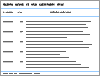
Resin-ceramic composites materials used and related information"
| 材料名称 | 材料品牌 | 生产国 | 材料类型 | 组成成分 | |
|---|---|---|---|---|---|
| 有机成分 | 无机成分 | ||||
| 润瓷 | 爱尔创 | 中国 | RNC | Bis-GMA、UDMA、TEGDMA | 55%~85%,硅酸盐玻璃填料 |
| Shofu Block HC | Shofu | 日本 | RNC | UDMA、TEGDMA | 61%,SiO2、微气相SiO2以及ZrSiO4等填料 |
| Vita Enamic | Vita | 德国 | PICN | UDMA、TEGDMA | 86%,富含氧化铝的精细结构长石陶瓷 |
Tab.2
Effect of different surface treatments on the three-point bending strength of resin-based ceramics $\bar{x} \pm s$,MPa"
| 材料 | 是否老化 | 表面处理 | |||
|---|---|---|---|---|---|
| NT | SB | HF | Er:YAG | ||
| 润瓷 | 否 | (215.64±17.36)Aa | (158.88±8.03)Ab | (203.23±7.22)Aa | (158.69±5.36)Ab |
| 是 | (161.77±13.58)Ba | (131.69±7.32)Bb | (159.02±12.49)Ba | (121.94±9.25)Bb | |
| Shofu Block HC | 否 | (160.20±12.53)Aa | (135.72±17.68)Aa | (148.22±10.88)Aa | (92.60±8.98)Ab |
| 是 | (131.78±7.72)Ba | (110.21±7.86)Bb | (127.90±9.98)Ba | (71.76±12.02)Bc | |
| Vita Enamic | 否 | (146.28±12.67)Aa | (124.53±6.24)Ab | (142.72±7.37)Aa | (130.19±12.10)Ab |
| 是 | (127.07±8.11)Ba | (122.07±6.58)Aa | (124.02±8.47)Ba | (123.88±3.48)Aa | |
Tab.3
Two-way ANOVA of the effects of surface treatment and thermocycling on the three-point flexural strength"
| 变量(源) | 材料 | 平方和 | 自由度 | 均方 | F | P |
|---|---|---|---|---|---|---|
| 表面处理 | 润瓷 | 36 295.776 | 3 | 12 098.592 | 104.493 | <0.001* |
| Shofu Block HC | 48 398.852 | 3 | 16 132.951 | 124.848 | <0.001* | |
| Vita Enamic | 2 189.502 | 3 | 729.834 | 9.843 | <0.001* | |
| 冷热循环 | 润瓷 | 32 810.913 | 1 | 32 810.913 | 283.382 | <0.001* |
| Shofu Block HC | 11 305.954 | 1 | 1 105.954 | 87.494 | <0.001* | |
| Vita Enamic | 2 724.420 | 1 | 2 724.420 | 36.744 | <0.001* | |
| 表面处理×冷热循环 | 润瓷 | 1 919.854 | 3 | 639.951 | 5.527 | <0.001* |
| Shofu Block HC | 225.592 | 3 | 75.197 | 0.582 | 0.629 | |
| Vita Enamic | 1 099.642 | 3 | 366.547 | 4.944 | 0.004* | |
| 误差 | 润瓷 | 8 336.397 | 72 | 115.783 | ||
| Shofu Block HC | 9 303.865 | 72 | 129.220 | |||
| Vita Enamic | 5 338.474 | 72 | 74.145 |
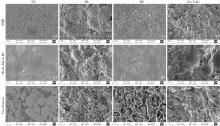
Fig.1
SEM surface morphology of each group of materials(bar=3 μm)"

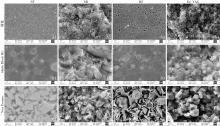
Fig.2
SEM surface morphology of each group of materials after thermocycling(bar=3 μm)"

| [1] |
Bajraktarova-Valjakova E, Korunoska-Stevkovska V, Kapusevska B, et al. Contemporary dental ceramic materials, a review: Chemical composition, physical and mechanical properties, indications for use[J]. Open Access Maced J Med Sci, 2018, 6(9): 1742-1755.
doi: 10.3889/oamjms.2018.378 pmid: 30338002 |
| [2] | Fouquet V, Lachard F, Abdel-Gawad S, et al. Shear bond strength of a direct resin composite to CAD-CAM composite blocks: Relative contribution of micromechanical and chemical block surface treatment[J]. Materials(Basel), 2022, 15(14): 5018. |
| [3] |
Alqerban A. Lithium di silicate ceramic surface treated with Er, Cr: YSGG and other conditioning regimes bonded to orthodontic bracket[J]. Saudi Dent J, 2021, 33(4): 188-193.
doi: 10.1016/j.sdentj.2019.11.012 |
| [4] | 裴挫萍. 不同激光蚀刻技术对陶瓷与复合树脂材料粘接强度的影响研究[J]. 化学与粘合, 2022, 44(6): 491-495,521. |
| [5] | Tekçe N, Tuncer S, Demirci M, et al. Microtensile bond strength of CAD/CAM resin blocks to dual-cure adhesive cement:The effect of different sandblasting procedures[J]. J Prosthodont, 2019, 28(2): e485-e490. |
| [6] |
Usta Kutlui I, Yerliyurt K. The impact of various surface treatments and Er-YAG laser irradiation on the bond strength of resin matrix CAD/CAM ceramics to resin cement[J]. Lasers Med Sci, 2025, 40(1): 201.
doi: 10.1007/s10103-025-04460-5 |
| [7] |
Muhammed HA, Mahmoud EM, Fahmy AE, et al. The effect of sandblasting versus acid etching on the surface roughness and biaxial flexural strength of CAD/CAM resin-matrix ceramics(In vitro study)[J]. BMC Oral Health, 2023, 23(1): 169.
doi: 10.1186/s12903-023-02883-6 pmid: 36964539 |
| [8] | Kurtulmus-Yilmaz S, Cengiz E, Ongun S, et al. The effect of surface treatments on the mechanical and optical behaviors of CAD/CAM restorative materials[J]. J Prosthodont, 2019, 28(2): e496-e503. |
| [9] | International Organization for Standardization. Dentisry ceramic materials: ISO 6872: 2015[S]. Switzerland: ISO, 2015: 7-16. |
| [10] |
Kassotakis EM, Stavridakis M, Bortolotto T, et al. Evaluation of the effect of different surface treatments on luting CAD/CAM composite resin overlay workpieces[J]. J Adhes Dent, 2015, 17(6): 521-528.
doi: 10.3290/j.jad.a35256 pmid: 26734676 |
| [11] | da Silva PNF, Martinelli-Lobo CM, Bottino MA, et al. Bond strength between a polymer-infiltrated ceramic network and a composite for repair: Effect of several ceramic surface treatments[J]. Braz Oral Res, 2018, 32: e28. |
| [12] | Cho SD, Rajitrangson P, Matis BA, et al. Effect of Er, Cr: YSGG laser, air abrasion, and silane application on repaired shear bond strength of composites[J]. Oper Dent, 2013, 38(3): E1-E9. |
| [13] |
杜亚鑫, 王强, 仇丽鸿. 不同表面处理方式对润瓷与树脂水门汀黏结强度的影响研究[J]. 中国实用口腔科杂志, 2020, 13(3): 157-161.
doi: 10.19538/j.kq.2020.03.005 |
| [14] | 孙硕遥. 氧等离子体处理对树脂纳米陶瓷粘接性能的影响[D]. 济南: 山东大学, 2024. |
| [15] |
Motevasselian F, Amiri Z, Chiniforush N, et al. In vitro evaluation of the effect of different surface treatments of a hybrid ceramic on the microtensile bond strength to a luting resin cement[J]. J Lasers Med Sci, 2019, 10(4): 297-303.
doi: 10.15171/jlms.2019.48 pmid: 31875122 |
| [16] |
Poosti M, Jahanbin A, Mahdavi P, et al. Porcelain conditioning with Nd: YAG and Er: YAG laser for bracket bonding in orthodontics[J]. Lasers Med Sci, 2012, 27(2): 321-324.
doi: 10.1007/s10103-010-0878-6 |
| [17] |
Akin H, Tugut F, Akin GE, et al. Effect of Er: YAG laser application on the shear bond strength and microleakage between resin cements and Y-TZP ceramics[J]. Lasers Med Sci, 2012, 27(2): 333-338.
doi: 10.1007/s10103-011-0883-4 |
| [18] | Yoshihara K NagaokaN, Maruo Y, et al. Sandblasting may damage the surface of composite CAD-CAM blocks[J]. Dent Mater, 2017, 33(3): e124-e135. |
| [19] |
Barutcigil K, Barutcigil Ç, Kul E, et al. Effect of different surface treatments on bond strength of resin cement to a CAD/CAM restorative material[J]. J Prosthodont, 2019, 28(1): 71-78.
doi: 10.1111/jopr.12574 pmid: 27880028 |
| [20] |
Jung SN, Rüttermann S. Influence of mechanical and chemical pre-treatments on the repair of a hybrid ceramic[J]. Dent Mater, 2022, 38(7): 1140-1148.
doi: 10.1016/j.dental.2022.05.003 pmid: 35672161 |
| [21] |
Peumans M, Valjakova EB, De Munck J, et al. Bonding effectiveness of luting composites to different CAD/CAM materials[J]. J Adhes Dent, 2016, 18(4): 289-302.
doi: 10.3290/j.jad.a36155 pmid: 27222889 |
| [22] |
Prochnow C, Venturini AB, Grasel R, et al. Effect of etching with distinct hydrofluoric acid concentrations on the flexural strength of a lithium disilicate-based glass ceramic[J]. J Biomed Mater Res B Appl Biomater, 2017, 105(4): 885-891.
doi: 10.1002/jbm.b.v105.4 |
| [23] |
El-Damanhoury HM, Elsahn NA, Sheela S, et al. Adhesive luting to hybrid ceramic and resin composite CAD/CAM Blocks: Er: YAG Laser versus chemical etching and micro-abrasion pretreatment[J]. J Prosthodont Res, 2021, 65(2): 225-234.
doi: 10.2186/jpr.JPOR_2020_50 |
| [24] |
Dursun MN, Ergin E, Ozgunaltay G. The effect of different surface preparation methods and various aging periods onmicrotensile bond strength for composite resin repair[J]. Niger J Clin Pract, 2021, 24(2): 282-291.
doi: 10.4103/njcp.njcp_83_20 pmid: 33605921 |
| [25] |
Çakmak G, Subaşı MG, Yilmaz B. Effect of thermocycling on the surface properties of resin-matrix CAD-CAM ceramics after different surface treatments[J]. J Mech Behav Biomed Mater, 2021, 117: 104401.
doi: 10.1016/j.jmbbm.2021.104401 |
| Viewed | ||||||
|
Full text |
|
|||||
|
Abstract |
|
|||||
