
Stomatology ›› 2026, Vol. 46 ›› Issue (4): 283-288.doi: 10.13591/j.cnki.kqyx.2026.04.008
• Basic and Clinical Research • Previous Articles Next Articles
ZHONG Yue1,2,3, LYU Dan4, ZHANG Yiyin4, HUANG Ziming4, ZHANG Yuan1,2,3, XIE Lizhe1,2,3, QIAN Yajing1,2,3( )
)
Received:2025-10-09
Online:2026-04-28
Published:2026-04-17
CLC Number:
ZHONG Yue, LYU Dan, ZHANG Yiyin, HUANG Ziming, ZHANG Yuan, XIE Lizhe, QIAN Yajing. Facial soft tissue changes in adults after orthodontic treatment based on 3dMD technology[J]. Stomatology, 2026, 46(4): 283-288.
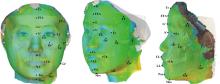
Fig.1
Schematic diagram of facial soft tissue landmarks"
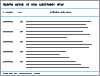
Tab.1
Facial soft tissue landmarks"
| 软组织标志点 | 定义 |
|---|---|
| 发际点,Tr | 解剖前额的最上点 |
| 临床前额中心点,FFA | 发际点和眉间点的中点 |
| 额颞点,FT | 外眦点斜向上45°与发际线的交点 |
| 眉间点,G' | 两眉弓间正中矢状面上的最凸点 |
| 软组织鼻根点,N' | 软组织侧面上相应的鼻根点 |
| 内眦点,En | 内眼角区域的最前点 |
| 外眦点,Ex | 外眼角区域的最后点 |
| 软组织眶点,Or' | 眶下缘最低点对应的软组织标志点 |
| 颧骨前点,Zp | 正面观颧部最向前、向外突出点 |
| 耳屏点,T | 外耳道前方耳屏软骨上缘起始部 |
| 上唇突点,UL | 上唇的最突点 |
| 下唇突点,LL | 下唇的最突点 |
| 口角点,Ch | 上下唇两侧方的联合处 |
| 软组织颏前点,Pos | 颏部的最突点 |
| 软组织颏下点,Mes | 颏部的最下点 |
| 下颌角点,Go' | 下颌角软组织转折点 |
| 下颌下缘中点,Mn' | 下颌角点与软组织颏下点的中点 |
Tab.2
Demographic characteristics of the study population n(%)"
| 项目 | 分类 | 治疗组 (n=52) | 对照组 (n=17) |
|---|---|---|---|
| 性别 | 男性 | 12(23.1) | 4(23.5) |
| 女性 | 40(76.9) | 13(76.5) | |
| 年龄组 | 18~25岁 | 34(65.4) | 12(70.6) |
| 26~35岁 | 18(34.6) | 5(29.4) | |
| 观察时间 | 1~2年(含2年) | 28(53.8) | 17(100) |
| 2~4年 | 24(46.2) | 0(0) | |
| 拔除第三磨牙情况 | 不拔第三磨牙 | 35(67.3) | 15(88.2) |
| 拔除第三磨牙 | 17(32.7) | 2(11.8) |
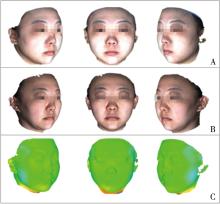
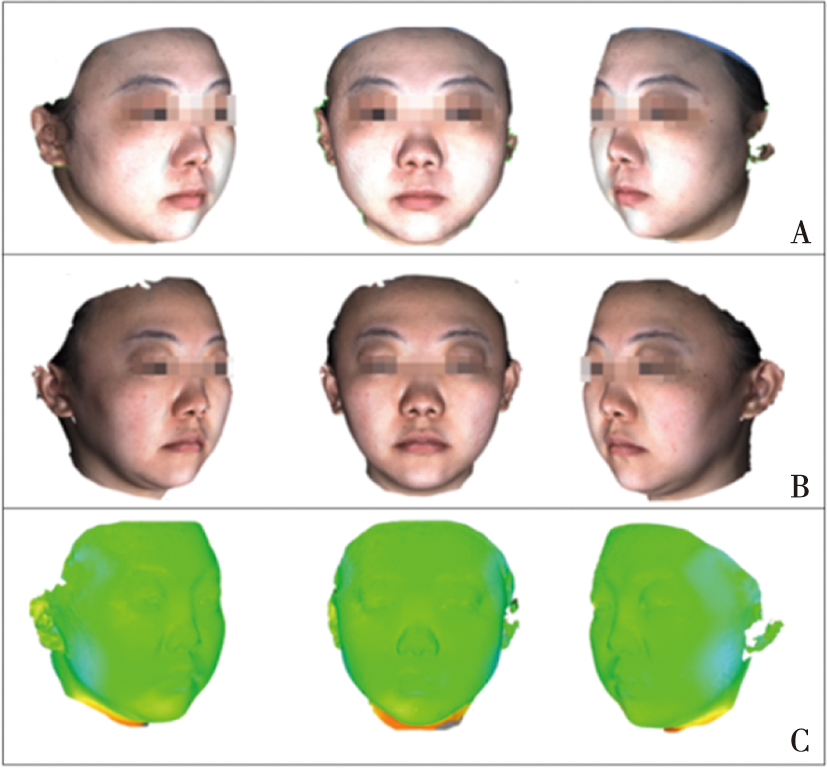
Fig.2
Superimposed images of facial soft tissues before and after orthodontic treatment"
Tab.3
Comparison of changes in bilateral homologous landmarks in the study population $\bar{x} \pm s$"
| 软组织标志点 | 治疗组(T1-T0) | P | 对照组(T1'-T0') | P | ||||||||
|---|---|---|---|---|---|---|---|---|---|---|---|---|
| 右侧 | 左侧 | 右侧 | 左侧 | |||||||||
| 额颞点 | -0.66±0.96 | -0.81±1.10 | 0.144 | 0.09±0.35 | 0.20±0.33 | 0.275 | ||||||
| 内眦点 | -0.05±0.40 | -0.08±0.50 | 0.643 | 0.17±0.31 | 0.14±0.33 | 0.712 | ||||||
| 外眦点 | 0.15±0.58 | 0.04±0.84 | 0.403 | 0.14±0.32 | 0.16±0.37 | 0.862 | ||||||
| 软组织眶点 | -0.05±0.50 | -0.12±0.52 | 0.383 | -0.03±0.43 | 0.06±0.45 | 0.344 | ||||||
| 颧骨前点 | -0.03±0.77 | -0.11±0.75 | 0.204 | 0.12±0.34 | 0.20±0.43 | 0.513 | ||||||
| 耳屏点 | 0.01±0.75 | -0.15±0.81 | 0.163 | 0.10±0.45 | 0.22±0.29 | 0.167 | ||||||
| 口角点 | -0.41±1.30 | -0.47±1.30 | 0.668 | 0.08±0.29 | -0.02±0.37 | 0.357 | ||||||
| 下颌角点 | -0.50±1.20 | -0.58±1.30 | 0.475 | 0.15±0.90 | -0.02±1.20 | 0.344 | ||||||
| 下颌下缘中点 | 0.20±0.88 | 0.06±0.98 | 0.181 | 0.17±0.57 | 0.21±0.77 | 0.699 | ||||||
Tab.4
Facial soft tissue landmark changes at various observation time points in the study population $\bar{x} \pm s$"
| 软组织标志点 | 治疗组 | 对照组 | 组间P | |||||||||
|---|---|---|---|---|---|---|---|---|---|---|---|---|
| 变化量(T1-T0) | P | 变化量(T1'-T0') | P | |||||||||
| 眉间点 | 0.00±0.45 | — | 0.00±0.32 | — | 0.960 | |||||||
| 发际点 | 0.13±0.67 | 0.196 | -0.10±0.40 | 0.303 | 0.174 | |||||||
| 临床前额中心点 | -0.02±0.50 | 0.768 | -0.15±0.41 | 0.080 | 0.327 | |||||||
| 额颞点 | -0.66±0.96 | <0.001* | 0.09±0.35 | 0.538 | 0.003# | |||||||
| 软组织鼻根点 | -0.06±0.54 | 0.389 | -0.14±0.40 | 0.210 | 0.584 | |||||||
| 内眦点 | -0.05±0.40 | 0.480 | 0.17±0.31 | 0.062 | 0.051 | |||||||
| 外眦点 | 0.15±0.58 | 0.137 | 0.14±0.32 | 0.224 | 0.767 | |||||||
| 软组织眶点 | -0.05±0.50 | 0.512 | -0.03±0.43 | 0.805 | 0.664 | |||||||
| 颧骨前点 | -0.03±0.77 | 0.797 | 0.12±0.34 | 0.339 | 0.422 | |||||||
| 耳屏点 | 0.01±0.75 | 0.941 | 0.10±0.45 | 0.435 | 0.380 | |||||||
| 上唇突点 | -0.31±1.30 | 0.111 | -0.14±0.33 | 0.064 | 0.694 | |||||||
| 下唇突点 | 0.08±1.60 | 0.749 | -0.20±0.57 | 0.109 | 0.478 | |||||||
| 口角点 | -0.41±1.30 | 0.037* | 0.08±0.29 | 0.433 | 0.136 | |||||||
| 软组织颏前点 | 0.12±1.60 | 0.623 | -0.22±0.44 | 0.053 | 0.404 | |||||||
| 软组织颏下点 | 0.06±1.30 | 0.882 | 0.04±0.65 | 0.824 | 0.943 | |||||||
| 下颌角点 | -0.50±1.20 | 0.016* | 0.15±0.90 | 0.545 | 0.042# | |||||||
| 下颌下缘中点 | 0.20±0.88 | 0.189 | 0.17±0.57 | 0.342 | 0.871 | |||||||
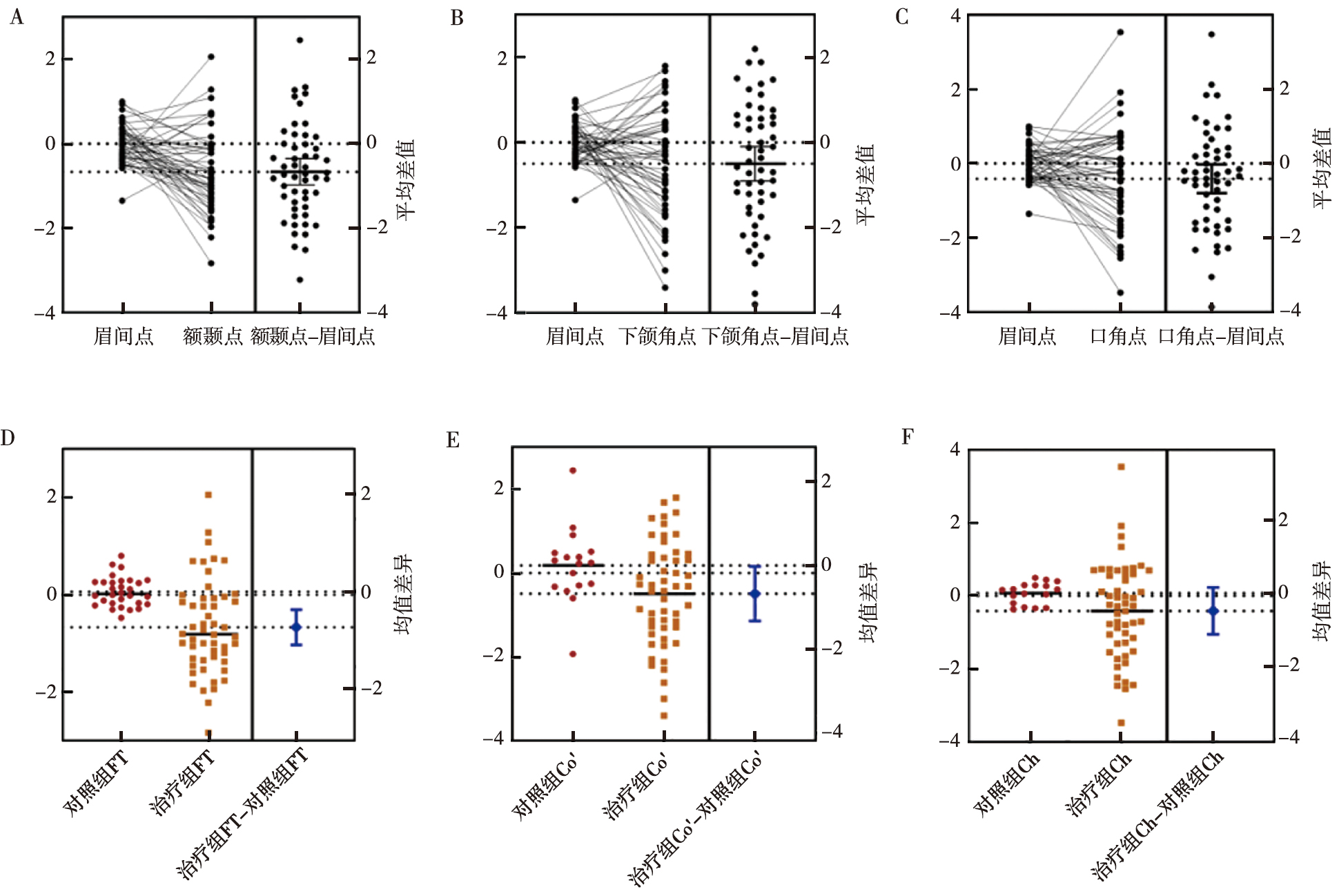
Fig.3
Comparison of changes in facial soft tissue landmarks in the study population"
Tab.5
Differences in the amount of changes in facial soft tissue landmarks across different treatment durations in the treatment group"
| 软组织标志点 | 治疗1~2年组 | 治疗2~4年组 | P |
|---|---|---|---|
| 眉间点 | -0.09±0.51 | 0.07±0.46 | 0.243 |
| 发际点 | 0.08±0.76 | 0.20±0.56 | 0.185 |
| 临床前额中心点 | -0.05±0.46 | 0.03±0.54 | 0.549 |
| 额颞点 | -0.42±1.03 | -0.95±0.82 | 0.047* |
| 软组织鼻根点 | -0.16±0.55 | 0.05±0.53 | 0.348 |
| 内眦点 | -0.04±0.40 | -0.06±0.41 | 0.862 |
| 外眦点 | 0.11±0.52 | 0.19±0.65 | 0.631 |
| 软组织眶点 | -0.11±0.45 | 0.03±0.54 | 0.591 |
| 颧骨前点 | 0.13±0.73 | -0.22±0.78 | 0.156 |
| 耳屏点 | 0.22±0.73 | -0.23±0.71 | 0.065 |
| 上唇突点 | -0.02±1.36 | -0.65±1.16 | 0.082 |
| 下唇突点 | 0.63±1.30 | -0.56±1.67 | 0.006* |
| 口角点 | -0.15±1.28 | -0.71±1.30 | 0.127 |
| 软组织颏前点 | 0.18±1.87 | 0.05±1.32 | 0.772 |
| 软组织颏下点 | 0.06±1.53 | 0.07±1.13 | 0.710 |
| 下颌角点 | -0.13±1.14 | -0.92±1.23 | 0.019* |
| 下颌下缘中点 | 0.48±0.85 | -0.12±0.81 | 0.014* |
| [1] |
Romero-Maroto M, Santos-Puerta N, González Olmo MJ, et al. The impact of dental appearance and anxiety on self-esteem in adult orthodontic patients[J]. Orthod Craniofac Res, 2015, 18(3): 143-155.
doi: 10.1111/ocr.12091 pmid: 25809714 |
| [2] | 高洁. 正畸治疗对成人面部软组织影响的三维初步探索研究[D]. 西安: 第四军医大学, 2017. |
| [3] |
李芷悦, 庞光明, 施优灵. 颏部与唇部位置关系对美观影响的三维美学分析[J]. 口腔医学研究, 2023, 39(7): 628-633.
doi: 10.13701/j.cnki.kqyxyj.2023.07.012 |
| [4] |
Lee R, Hwang S, Lim H, et al. Treatment satisfaction and its influencing factors among adult orthodontic patients[J]. Am J Orthod Dentofac Orthop, 2018, 153(6): 808-817.
doi: 10.1016/j.ajodo.2017.09.015 |
| [5] | 马艳宁, 金作林. 口腔正畸与颌面部美学[J]. 华西口腔医学杂志, 2023, 41(6): 628-634. |
| [6] |
Gao J, Wang X, Qin ZX, et al. Profiles of facial soft tissue changes during and after orthodontic treatment in female adults[J]. BMC Oral Health, 2022, 22(1): 257.
doi: 10.1186/s12903-022-02280-5 pmid: 35754041 |
| [7] |
Shaw RB Jr, Kahn DM. Aging of the midface bony elements: A three-dimensional computed tomographic study[J]. Plast Reconstr Surg, 2007, 119(2): 675-681;discussion682-683.
doi: 10.1097/01.prs.0000246596.79795.a8 pmid: 17230106 |
| [8] | Surek CC, Beut J, Stephens R, et al. Pertinent anatomy and analysis for midface volumizing procedures[J]. Plast Reconstr Surg, 2015, 135(5): 818e-829e. |
| [9] | Windhager S, Mitteroecker P, Rupić I, et al. Facial aging trajectories: A common shape pattern in male and female faces is disrupted after menopause[J]. Am J Physic Anthrop, 2019, 169(4): 678-688. |
| [10] | 谢天伊, 贾绮林. 成年女性正畸患者颊颞部软组织变化的三维测量研究[J]. 中华口腔正畸学杂志, 2020, 27(4): 181-186. |
| [11] | 李芷悦, 施优灵, 庞光明. 正畸治疗中软组织美学评价的研究进展[J]. 临床口腔医学杂志, 2022, 38(7): 441-444. |
| [12] | 靳远, 李炜鹏, 杨艳, 等. 正畸治疗对成年女性颊部丰满度影响的初步研究[J]. 中华口腔正畸学杂志, 2015, 22(1): 24-27. |
| [13] | Aras I, Ölmez S, Akay MC, et al. The effects of maxillary expansion on the soft tissue facial profile[J]. J Istanbul Univ Fac Dent, 2017, 51(2): 1-10. |
| [14] |
Liu C, Du SY, Wang ZL, et al. Impact of orthodontic-induced facial morphology changes on aesthetic evaluation: A retrospective study[J]. BMC Oral Health, 2024, 24(1): 24.
doi: 10.1186/s12903-023-03776-4 pmid: 38183059 |
| [15] | Mai HN, Lee DH. Accuracy of mobile device-compatible 3D scanners for facial digitization: Systematic review and meta-analysis[J]. J Med Internet Res, 2020, 22(10): e22228. |
| [16] | 罗婧美, 唐婉容, 郑延延. 数字化面部扫描技术的发展与应用[J]. 口腔医学, 2025, 45(6):470-474. |
| [17] | 刘沼汛, 张军梅, 郑之峻. 成年人正畸治疗与颧、颊、颞部软组织变化研究进展[J]. 陕西医学杂志, 2024, 53(2): 274-276,289. |
| [18] |
Dai FF, Yu J, Chen G, et al. Changes in buccal facial depth of female patients after extraction and nonextraction orthodontic treatments: A preliminary study[J]. Korean J Orthod, 2018, 48(3): 172-181.
doi: 10.4041/kjod.2018.48.3.172 pmid: 29732303 |
| [19] | 禹洁, 陈贵, 许天民, 等. 成人拔牙正畸后面部软组织变化的三维研究[J]. 中华口腔正畸学杂志, 2018, 25(2): 103-107. |
| [20] |
Janson G, Junqueira CHZ, Mendes LM, et al. Influence of premolar extractions on long-term adult facial aesthetics and apparent age[J]. Eur J Orthod, 2016, 38(3): 272-280.
doi: 10.1093/ejo/cjv039 |
| [21] | 袁玲君, 毛丽霞, 夏韫晖, 等. 成人非拔牙正畸后面部软组织变化的三维测量研究[C]// 2016中国国际正畸大会暨第十五次全国口腔正畸学术会议论文汇编. 西安, 2016: 365. |
| [22] |
操亚波, 傅露, 何柳, 等. 利用三维扫描技术评价成年女性正畸治疗前后面部软组织变化的研究[J]. 口腔医学研究, 2025, 41(1): 50-54.
doi: 10.13701/j.cnki.kqyxyj.2025.01.010 |
| [23] | GülAmuk N, Topsakal KG, Baser Keklikci H. Effects of different head positioning methods on facial soft tissue analysis using stereophotogrammetry[J]. J Oral Maxillofac Surg, 2019, 77(6): 1277. e1-1277. e10. |
| Viewed | ||||||
|
Full text |
|
|||||
|
Abstract |
|
|||||
