
Stomatology ›› 2026, Vol. 46 ›› Issue (9): 652-657.doi: 10.13591/j.cnki.kqyx.2026.09.002
• Basic and Clinical Research • Previous Articles Next Articles
JI Zhongqian1, WANG Han2, DING Tao1, XIE Lizhe1, HU Jian1( )
)
Received:2025-09-01
Online:2026-09-28
Published:2026-09-20
CLC Number:
JI Zhongqian, WANG Han, DING Tao, XIE Lizhe, HU Jian. Study on the correlation between the wear characteristics of maxillary first molars and posterior dentition[J]. Stomatology, 2026, 46(9): 652-657.
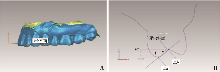
Fig.1
Measurement mode of cusp height and cusp inclination"
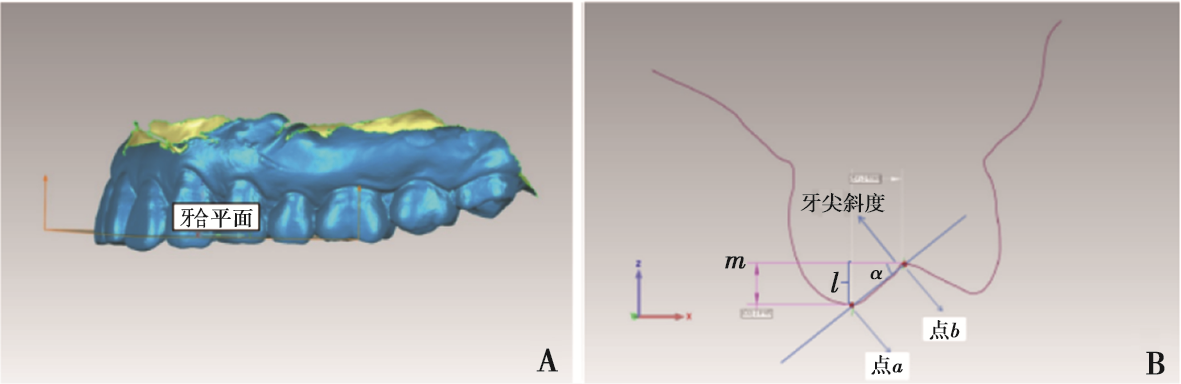
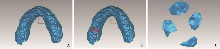
Fig.2
Diagram of the wear area measurement mode"
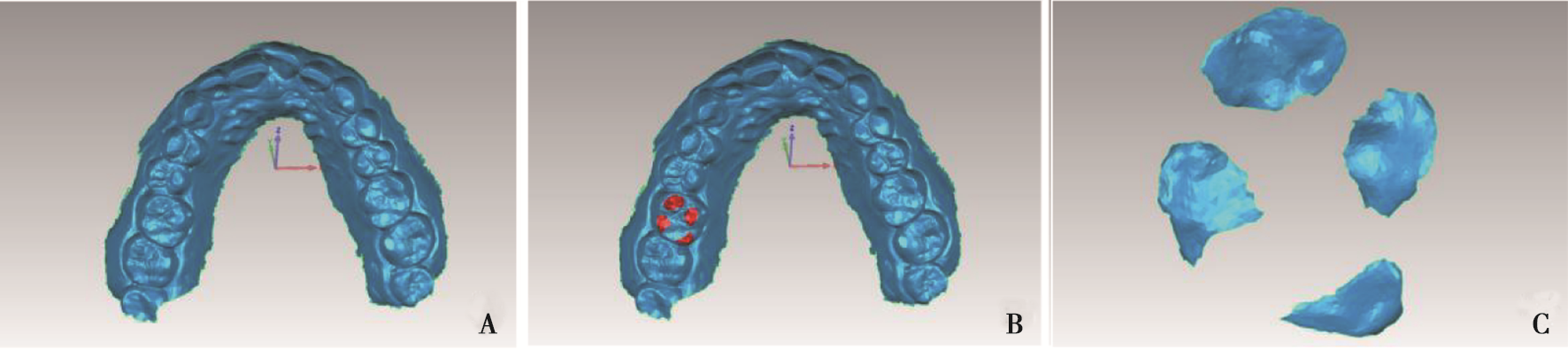
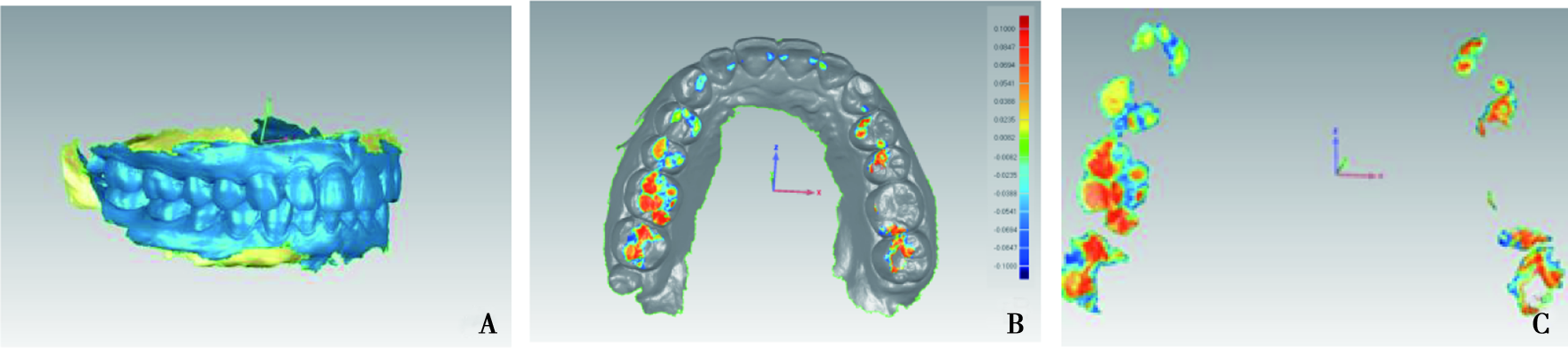
Fig.3
Schematic diagram of the measurement process of occlusal contact area"
Tab.1
Descriptive statistics of variables"
| 牙位 | 牙尖 | 磨耗面积/ mm2 | 牙尖高度/ mm | 牙尖斜度/ (°) | 咬合接触 面积/mm2 |
|---|---|---|---|---|---|
| 上4 | B | 7.87±3.15 | 2.46±0.55 | 39.75±8.18 | 8.83±5.62 |
| P | 3.96±2.58 | 1.49±0.48 | 31.20±8.21 | ||
| 上5 | B | 5.65±2.87 | 2.12±0.48 | 36.09±6.74 | 8.87±5.76 |
| P | 3.56±2.07 | 1.40±0.48 | 29.42±8.84 | ||
| 上6 | MB | 9.02±4.62 | 1.57±0.49 | 25.58±7.05 | 20.77±13.95 |
| DB | 7.47±3.76 | 1.61±0.49 | 27.30±7.20 | ||
| MP | 12.34±4.79 | 1.81±0.47 | 32.64±7.86 | ||
| DP | 8.55±4.03 | 1.33±0.48 | 25.86±7.52 | ||
| 上7 | MB | 7.82±4.25 | 1.19±0.48 | 20.96±6.99 | 18.73±12.46 |
| DB | 5.39±2.96 | 1.04±0.50 | 20.79±7.01 | ||
| MP | 12.55±5.47 | 2.08±0.54 | 35.49±8.61 | ||
| DP | 4.49±3.12 | 1.36±0.64 | 28.99±9.64 |
Tab.2
Differences of wear area between genders"
| 性别 | 人数 | 磨耗面积/mm2 | t | P |
|---|---|---|---|---|
| 男 | 80 | 36.97±11.92 | 1.463 | 0.145 |
| 女 | 116 | 34.29±12.41 |
Tab.3
Simple linear regression of age and wear area"
| 因变量 | 自变量 | 非标准化 系数 | 标准化 系数 | t | P | r2 | ||
|---|---|---|---|---|---|---|---|---|
| B | 标准误 | β | ||||||
| 上颌第一 磨牙总磨 耗面积 | 年龄 | 0.525 | 0.067 | 0.574 | 9.359 | <0.001 | 0.329 | |
Tab.4
Correlation analysis between variables r"
| 变量 | 上6MB 磨耗面积 | 上6DB 磨耗面积 | 上6MP 磨耗面积 | 上6DP 磨耗面积 | 上6总 磨耗面积 |
|---|---|---|---|---|---|
| 上4B磨耗面积 | 0.278* | 0.326 | 0.224* | 0.164* | 0.304* |
| 上4P磨耗面积 | 0.115 | 0.424 | 0.246* | 0.244* | 0.282* |
| 上4B牙尖高度 | -0.062 | -0.002 | -0.079 | 0.079 | -0.249 |
| 上4P牙尖高度 | -0.216* | -0.227* | -0.233* | -0.201 | -0.047 |
| 上4B牙尖斜度 | -0.196 | -0.089 | -0.232* | 0.011 | -0.197* |
| 上4P牙尖斜度 | -0.214* | -0.246* | -0.232* | -0.286* | -0.303 |
| 上4接触面积 | 0.188* | 0.266* | 0.145 | 0.159* | 0.074 |
| 上5B磨耗面积 | 0.371* | 0.436* | 0.423* | 0.412* | 0.506* |
| 上5P磨耗面积 | 0.270* | 0.461 | 0.357* | 0.257* | 0.339* |
| 上5B牙尖高度 | -0.006 | -0.042 | -0.025 | -0.016 | -0.366* |
| 上5P牙尖高度 | -0.302* | -0.328* | -0.349* | -0.209* | 0.056 |
| 上5B牙尖斜度 | -0.050 | -0.081 | -0.065 | -0.066 | -0.112 |
| 上5P牙尖斜度 | -0.287* | -0.281* | -0.322* | -0.241* | -0.361 |
| 上5接触面积 | 0.289* | 0.258* | 0.167* | 0.159* | 0.326* |
| 上6MB磨耗面积 | - | 0.543* | 0.626* | 0.450* | 0.805* |
| 上6DB磨耗面积 | 0.543* | - | 0.597* | 0.494* | 0.743* |
| 上6MP磨耗面积 | 0.626* | 0.597* | - | 0.497* | 0.853* |
| 上6DP磨耗面积 | 0.450* | 0.494* | 0.497* | - | 0.724* |
| 上6MB牙尖斜度 | 0.013 | 0.013 | 0.054 | -0.018 | 0.073 |
| 上6DB牙尖斜度 | -0.124 | -0.152* | -0.153* | -0.055 | -0.127 |
| 上6MP牙尖斜度 | -0.380* | -0.305* | -0.395* | -0.174* | -0.412* |
| 上6DP牙尖斜度 | -0.263* | -0.161* | -0.205* | -0.200* | -0.271* |
| 上6接触面积 | 0.296* | 0.227* | 0.194* | 0.245* | 0.313* |
| 上7MB磨耗面积 | 0.518* | 0.413* | 0.510* | 0.503* | 0.585* |
| 上7DB磨耗面积 | 0.355* | 0.424* | 0.444* | 0.502 | 0.528* |
| 上7MP磨耗面积 | 0.434* | 0.413* | 0.592* | 0.475* | 0.517* |
| 上7DP磨耗面积 | 0.368* | 0.414* | 0.453* | 0.464* | 0.514* |
| 上7MB牙尖斜度 | -0.160 | 0.130 | -0.073 | -0.038 | 0.077 |
| 上7DB牙尖斜度 | 0.050 | 0.043 | -0.010 | -0.013 | -0.004 |
| 上7MP牙尖斜度 | -0.160* | -0.198* | -0.202* | -0.146 | -0.251* |
| 上7DP牙尖斜度 | -0.237* | -0.148* | -0.148* | -0.113 | -0.169* |
| 上7接触面积 | 0.200* | 0.195 | 0.066 | 0.209* | 0.226 |
| 上4总磨耗面积 | 0.245* | 0.292* | 0.322* | 0.224* | 0.347* |
| 上5总磨耗面积 | 0.418* | 0.460* | 0.481* | 0.368* | 0.551* |
| 上7总磨耗面积 | 0.230* | 0.397* | 0.283* | 0.359* | 0.395* |
| 年龄 | 0.317* | 0.304* | 0.335* | 0.256* | 0.574* |
Tab.5
Multiple linear regression analysis of the four cusps of maxillary first molars"
| 因变量 | 自变量 | 非标准化系数 | 标准化系数 | t | P | r2 | VIF | F | |
|---|---|---|---|---|---|---|---|---|---|
| B | 标准误 | β | |||||||
| 上6MB磨耗面积 | 上7MB磨耗面积 | 0.464 | 0.066 | 0.425 | 7.057 | <0.001 | 0.370 | 1.098 | 36.088 |
| 上5B磨耗面积 | 0.471 | 0.087 | 0.326 | 5.420 | <0.001 | 1.098 | |||
| 上6DB磨耗面积 | 上7DB磨耗面积 | 0.203 | 0.058 | 0.184 | 1.208 | <0.001 | 0.374 | 2.734 | 29.858 |
| 上5P磨耗面积 | 0.497 | 0.105 | 0.304 | 6.892 | <0.001 | 1.005 | |||
| 上7MB磨耗面积 | 0.157 | 0.428 | 0.179 | 2.224 | <0.001 | 1.005 | |||
| 上6MP磨耗面积 | 上7MP磨耗面积 | 0.287 | 0.068 | 0.169 | 4.190 | 0.002 | 0.386 | 1.511 | 29.726 |
| 上5B磨耗面积 | 0.419 | 0.103 | 0.209 | 4.089 | <0.001 | 1.220 | |||
| 上4B牙尖斜度 | -0.099 | 0.030 | -0.232 | -3.240 | <0.001 | 1.071 | |||
| 上7DP磨耗面积 | 0.243 | 0.105 | 0.196 | 2.319 | 0.001 | 1.497 | |||
| 上6DP磨耗面积 | 上7MP磨耗面积 | 0.173 | 0.062 | -0.226 | 2.790 | <0.001 | 0.335 | 1.863 | 23.839 |
| 上7DP磨耗面积 | 0.221 | 0.086 | 0.187 | 2.555 | <0.001 | 1.531 | |||
| 上5B磨耗面积 | 0.210 | 0.082 | -0.164 | 2.553 | 0.006 | 1.172 | |||
| 上7MB磨耗面积 | 0.177 | 0.073 | 0.183 | 2.438 | 0.016 | 1.604 | |||
| 上6总磨耗面积 | 上5磨耗面积 | 1.564 | 0.241 | 0.363 | 6.539 | <0.001 | 0.457 | 1.118 | 82.272 |
| 上7MB磨耗面积 | 1.579 | 0.182 | 0.477 | 8.576 | <0.001 | 1.118 | |||
| [1] | Rebelo Vieira JM, Pereira JV, Sponchiado Júnior EC, et al. Prevalence of dental caries, periodontal disease, malocclusion, and tooth wear in indigenous populations in Brazil: A systematic review and meta-analysis[J]. Braz Oral Res, 2023, 37: e094. |
| [2] |
Pereira Cenci T, Cademartori MG, dos Santos LG, et al. Prevalence of tooth wear and associated factors: A birth cohort study[J]. J Dent, 2023, 128: 104386.
doi: 10.1016/j.jdent.2022.104386 |
| [3] |
Thomas DC, Singer SR, Markman S. Temporomandibular disorders and dental occlusion what do we know so far?[J]. Dent Clin N Am, 2023, 67(2): 299-308.
doi: 10.1016/j.cden.2022.11.002 |
| [4] | Fan JY, Caton JG. Occlusal trauma and excessive occlusal forces: Narrative review, case definitions, and diagnostic considerations[J]. J Clin Periodontol, 2018, 45(S20): S199-S206. |
| [5] | Aziz AM, Hamdoon Z, Husein AB, et al. Applications of artificial intelligence in restorative dentistry: A scoping review[J]. Quintessence Int, 2024, 55(6): 430-440. |
| [6] | Marta RL, Miguel GP, Shantanu V, et al. Artificial intelligence applications in restorative dentistry: A systematic review[J]. J Dent, 2022, 128(5):867-875. |
| [7] |
Jiang XT, Dai N, Cheng XS, et al. Robust tooth surface reconstruction by iterative deformation[J]. Comput Biol Med, 2016, 68: 90-100.
doi: 10.1016/j.compbiomed.2015.11.001 pmid: 26638148 |
| [8] |
Sadid-Zadeh R, Stylianou A, Aponte Wesson R. Prosthetic management of an existing transmandibular implant: A clinical report[J]. J Prosthet Dent, 2018, 119(5): 693-697.
doi: S0022-3913(17)30486-9 pmid: 28967398 |
| [9] |
Hsu MR, Driscoll CF, Romberg E, et al. Accuracy of dynamic virtual articulation: Trueness and precision[J]. J Prosthodont, 2019, 28(4): 436-443.
doi: 10.1111/jopr.13035 pmid: 30737975 |
| [10] |
Li LL, Chen H, Li WW, et al. Design of wear facets of mandibular first molar crowns by using patient-specific motion with an intraoral scanner: A clinical study[J]. J Prosthet Dent, 2023, 129(5): 710-717.
doi: 10.1016/j.prosdent.2021.06.048 |
| [11] | 马丽娅, 巢家瑞, 刘飞, 等. 基于下颌运动轨迹与虚拟𬌗架运动参数模拟调𬌗的对比研究[J]. 华西口腔医学杂志, 2023, 41(3):254-259. |
| [12] |
Olthoff LW, van der Zel JM, de Ruiter WJ, et al. Computer mo-deling of occlusal surfaces of posterior teeth with the CICERO CAD/CAM system[J]. J Prosthet Dent, 2000, 84(2): 154-162.
doi: 10.1067/mpr.2000.107785 pmid: 10946332 |
| [13] |
Mehl A, Blanz V, Hickel R. A new mathematical process for the calculation of average forms of teeth[J]. J Prosthet Dent, 2005, 94(6): 561-566.
doi: 10.1016/j.prosdent.2005.10.002 pmid: 16316803 |
| [14] |
Mehl A, Blanz V, Hickel R. Biogeneric tooth: A new mathematical representation for tooth morphology in lower first molars[J]. Eur J Oral Sci, 2005, 113(4): 333-340.
doi: 10.1111/j.1600-0722.2005.00224.x pmid: 16048526 |
| [15] | 袁福来, 戴宁, 田素坤, 等. 采用条件生成式对抗网络的缺损牙全冠修复技术[J]. 计算机辅助设计与图形学学报, 2019, 31(12): 2113-2120. |
| [16] |
Tian SK, Wang MH, Dai N, et al. DCPR-GAN: Dental crown prosthesis restoration using two-stage generative adversarial networks[J]. IEEE J Biomed Health Inform, 2022, 26(1): 151-160.
doi: 10.1109/JBHI.2021.3119394 |
| [17] |
Kardach H, Szponar-żurowska A, Biedziak B. A comparison of teeth measurements on plaster and digital models[J]. J Clin Med, 2023, 12(3): 943.
doi: 10.3390/jcm12030943 |
| [18] |
Lee H, Cha J, Chun YS, et al. Comparison of the occlusal contact area of virtual models and actual models: A comparative study on Class Ⅰ and Class Ⅱ malocclusion models[J]. BMC Oral Health, 2018, 18(1): 109.
doi: 10.1186/s12903-018-0566-7 |
| [19] |
Gillborg S, Åkerman S, Ekberg E. Tooth wear in Swedish adults: A cross-sectional study[J]. J Oral Rehabil, 2020, 47(2): 235-245.
doi: 10.1111/joor.12887 pmid: 31520545 |
| [20] |
Van’t Spijker A, Rodriguez JM, Kreulen CM, et al. Prevalence of tooth wear in adults[J]. Int J Prosthodont, 2009, 22(1): 35-42.
pmid: 19260425 |
| [21] |
Masotti S, Bogdanic N, Arnaud J, et al. Tooth wear pattern analysis in a sample of Italian Early Bronze Age population. Proposal of a 3-D sampling sequence[J]. Arch Oral Biol, 2017, 74: 37-45.
doi: S0003-9969(16)30299-0 pmid: 27871014 |
| [22] | 张煜雯, 严斌, 胡建. 颅面结构特征与牙列磨耗分布的相关性研究[J]. 口腔医学, 2020, 40(6): 540-543. |
| [23] |
Mijuskovic M, Gebistorf MC, Pandis N, et al. Tooth wear and gingival recession in 210 orthodontically treated patients: A retrospective cohort study[J]. Eur J Orthod, 2018, 40(4): 444-450.
doi: 10.1093/ejo/cjx083 |
| [24] |
Kaklamanos EG, Menexes G, Makrygiannakis MA, et al. Tooth wear in a sample of community-dwelling elderly greeks[J]. Oral Health Prev Dent, 2020, 18(2):133-138.
doi: 10.3290/j.ohpd.a43348 pmid: 32238984 |
| [25] | 肖小勇, 曾雨欣, 周静, 等. 新疆山普拉墓地古代居民的牙齿磨耗[J]. 第四纪研究, 2025, 45(1): 306-318. |
| [26] |
Littleton J. Dental wear and age grading at Roonka, South Australia[J]. Am J Phys Anthropol, 2017, 163(3): 519-530.
doi: 10.1002/ajpa.23226 pmid: 28374451 |
| [27] |
Littleton J, Scott R, McFarlane G, et al. Hunter-gatherer variability: Dental wear in South Australia[J]. Am J Phys Anthropol, 2013, 152(2): 273-286.
doi: 10.1002/ajpa.22358 pmid: 23999884 |
| [28] |
Woda A, Vigneron P, Kay D. Nonfunctional and functional occlusal contacts: A review of the literature[J]. J Prosthet Dent, 1979, 42(3): 335-341.
pmid: 383965 |
| [29] |
Sapkota B, Gupta A. Pattern of occlusal contacts in lateral excursions(canine protection or group function)[J]. Kathmandu Univ Med J, 2015, 12(1): 43-47.
doi: 10.3126/kumj.v12i1.13637 |
| [30] |
Francová K, Eber M, Zapletalová J. Functional occlusal patterns during lateral excursions in young adults[J]. J Prosthet Dent, 2015, 113(6): 571-577.
doi: 10.1016/j.prosdent.2014.12.004 pmid: 25796399 |
| [31] |
Ayuso-Montero R, Mariano-Hernandez Y, Khoury-Ribas L, et al. Reliability and validity of T-scan and 3D intraoral scanning for measuring the occlusal contact area[J]. J Prosthodont, 2020, 29(1): 19-25.
doi: 10.1111/jopr.13096 pmid: 31270888 |
| [32] |
Abdulateef S, Edher F, Hannam AG, et al. Clinical accuracy and reproducibility of virtual interocclusal records[J]. J Prosthet Dent, 2020, 124(6): 667-673.
doi: 10.1016/j.prosdent.2019.11.014 pmid: 32014284 |
| [33] | Abe KI, Sakaguchi K, Mehta NR, et al. Effect of body posture on stability and balance of occlusal contacts[J]. CRANIO®, 2025, 43(2): 225-235. |
| [34] |
Ruktanakit N, Thongudomporn U, Kwanyuang A. Effect of clenching intensity on areas of occlusal contact and near contact recorded by a 3D intraoral scanner[J]. J Oral Rehabil, 2025, 52(10): 1601-1607.
doi: 10.1111/joor.v52.10 |
| Viewed | ||||||
|
Full text |
|
|||||
|
Abstract |
|
|||||
