
Stomatology ›› 2025, Vol. 45 ›› Issue (11): 832-838.doi: 10.13591/j.cnki.kqyx.2025.11.006
• Basic and Clinical Research • Previous Articles Next Articles
LIU Jingyi1,2,3, ZHU Yuchi1,2,3, YANG Shengjun1,2,3, SI Yuan1,2,3, WANG Dongmiao1,2,3( )
)
Received:2024-12-22
Online:2025-11-28
Published:2025-11-18
Contact:
WANG Dongmiao
E-mail:wdm9921@njmu.edu.cn
CLC Number:
LIU Jingyi, ZHU Yuchi, YANG Shengjun, SI Yuan, WANG Dongmiao. Two different methods for vertical mandibular third molar extraction: A finite element analysis[J]. Stomatology, 2025, 45(11): 832-838.
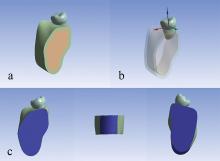
Fig.1
Finite element model"
Tab.1
Mechanical properties"
| 材料 | 杨氏模量/MPa | 泊松比 |
|---|---|---|
| 皮质骨 | 1 370 | 0.30 |
| 松质骨 | 11 760 | 0.25 |
| 牙本质 | 18 600 | 0.35 |
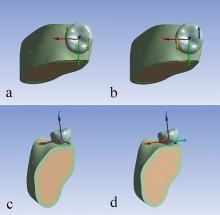
Fig.2
Sketch map of loading"

Tab.2
Loading condition"
| 时间 范围/s | 坐标轴 | 小角度旋转力/N | 颊舌向摇晃力/N | ||
|---|---|---|---|---|---|
| 颊侧 | 舌侧 | 颊侧 | 舌侧 | ||
| 0~3 | X | -3.052 | 3.052 | 34.867 | 34.867 |
| Y | -34.867 | 34.867 | 0 | 0 | |
| Z | 0 | 0 | -3.052 | 3.052 | |
| 3~6 | X | -3.052 | 3.052 | -34.867 | -34.867 |
| Y | 34.867 | -34.867 | 0 | 0 | |
| Z | 0 | 0 | 3.052 | -3.052 | |
| 总计 | 35 N,旋转角度为5°(即在XY平面上与Y轴夹角为5°) | 35 N,摇晃角度为5°(即在XZ平面上与X轴夹角为5°) | |||
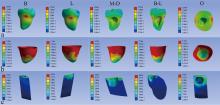
Fig.3
Von-Mises stress distribution of the small-angle intermittent rotation force"

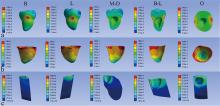
Fig.4
Strain distribution of the small-angle intermittent rotation force"

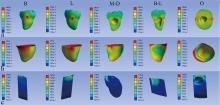
Fig.5
Von-Mises stress distribution of the buccal-lingual force"

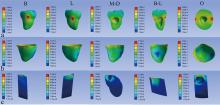
Fig.6
Strain distribution of the buccal-lingual force"

Tab.3
Average stress/strain"
| 位置 | 平均应力/MPa | 平均应变/mm | ||
|---|---|---|---|---|
| 旋转力 | 摇晃力 | 旋转力 | 摇晃力 | |
| 牙 | 1.56 | 1.62 | 9.53×10⁻⁵ | 1.03×10⁻⁴ |
| 牙周膜 | 9.90×10⁻¹ | 3.17×10⁻¹ | 1.83×10⁻¹ | 1.36×10⁻¹ |
| 牙槽骨 | 2.76×10⁻¹ | 6.05×10⁻¹ | 3.63×10⁻⁵ | 7.60×10⁻⁵ |
| [1] |
Carter K, Worthington S. Predictors of third molar impaction:A systematic review and meta-analysis[J]. J Dent Res, 2016, 95(3): 267-276.
doi: 10.1177/0022034515615857 pmid: 26561441 |
| [2] |
Sifuentes-Cervantes JS, Carrillo-Morales F, Castro-Núñez J, et al. Third molar surgery: Past, present, and the future[J]. Oral Surg Oral Med Oral Pathol Oral Radiol, 2021, 132(5): 523-531.
doi: 10.1016/j.oooo.2021.03.004 |
| [3] |
Huang C, Zhou C, Xu MH, et al. Risk factors for lingual plate fracture during mandibular third molar extraction[J]. Clin Oral Investig, 2020, 24(11): 4133-4142.
doi: 10.1007/s00784-020-03286-5 |
| [4] | 张志愿. 口腔颌面外科学[M]. 8版. 北京: 人民卫生出版社, 2020: 65-67. |
| [5] | Abdelwahab M, Nørholt SE, Taneja P. The efficacy of physics forceps for exodontia: A systematic review[J]. J Oral Maxillofac Surg, 2021, 79(5): 989.e1-989989.e13. |
| [6] | 胡开进. 标准拔牙手术图谱[M]. 2版. 北京: 人民卫生出版社, 2017: 45. |
| [7] |
Ma J, Zhang M, Yang DL, et al. Three-dimensional finite element analysis on stress distribution after different palatoplasty and levator veli palatini muscle reconstruction[J]. Clin Oral Investig, 2024, 28(4): 221.
doi: 10.1007/s00784-024-05583-9 |
| [8] | Guo RZ, Lam XY, Zhang LW, et al. Biomechanical analysis of miniscrew-assisted molar distalization with clear aligners: A three-dimensional finite element study[J]. Eur J Orthod, 2024, 46(1): cjad077. |
| [9] |
Zhu GY, Zhang B, Yao K, et al. Finite element analysis of the biomechanical effect of clear aligners in extraction space closure under different anchorage controls[J]. Am J Orthod Dentofacial Orthop, 2023, 163(5): 628-644.e11.
doi: 10.1016/j.ajodo.2022.02.018 |
| [10] |
王菲, 张馨月, 刘木清, 等. 顺牙长轴拔牙法在下颌近中与水平智齿拔除术中的应用及三维有限元分析[J]. 北京大学学报(医学版), 2025, 57(1):106-112.
doi: 10.19723/j.issn.1671-167X.2025.01.016 |
| [11] | 姚超, 辛海燕, 高菲, 等. 下颌阻生第三磨牙及其邻近结构三维有限元模型的建立及分析[J]. 中国现代医药杂志, 2020, 22(12): 10-13. |
| [12] |
Ma Y, Xu X, Liu QM, et al. A finite element analysis on the indication for extracting partially impacted mandibular third molars considering mandibular trauma[J]. BMC Oral Health, 2024, 24(1): 989.
doi: 10.1186/s12903-024-04743-3 pmid: 39180028 |
| [13] | 华成舸. 微创拔牙的刚体力学分析[J]. 华西口腔医学杂志, 2017, 35(2): 119-123. |
| [14] | 王兴. 刚体力学在下颌阻生第三磨牙拔除术中的理论和应用探索[J]. 中华口腔医学杂志, 2025, 60(2): 109-115. |
| [15] | Nakamura Y, Kanbara R, Ochiai KT, et al. A finite element evaluation of mechanical function for 3 distal extension partial dental prosthesis designs with a 3-dimensional nonlinear method for modeling soft tissue[J]. 2014, 112(4): 972-980. |
| [16] |
Adell R. Tissue integrated prostheses in clinical dentistry[J]. Int Dent J, 1985, 35(4): 259-265.
pmid: 3912327 |
| [17] |
Li YX, Xiao SZ, Jin Y, et al. Stress and movement trend of lower incisors with different IMPA intruded by clear aligner: A three-dimensional finite element analysis[J]. Prog Orthod, 2023, 24(1): 5.
doi: 10.1186/s40510-023-00454-7 pmid: 36775824 |
| [18] |
Kanbara R, Nakamura Y, Ochiai KT, et al. Three-dimensional finite element stress analysis: The technique and methodology of non-linear property simulation and soft tissue loading behavior for different partial denture designs[J]. Dent Mater J, 2012, 31(2): 297-308.
pmid: 22447065 |
| [19] | Wang DC, Akbari A, Jiang FF, et al. The effects of different types of periodontal ligament material models on stresses computed using finite element models[J]. Am J Orthod Dentofacial Orthop, 2022, 162(6): e328-e336. |
| [20] |
Xu W, Shen J, Li KC, et al. A mechanical and three-dimensional finite element study of the optimum tooth sectioning depth during the extraction of low-level horizontally impacted mandibular third molar[J]. Odontology, 2024, 112(1): 242-249.
doi: 10.1007/s10266-023-00822-z |
| [21] |
Wan BY, Chung BH, Zhang MR, et al. The effect of varying occlusal loading conditions on stress distribution in roots of sound and instrumented molar teeth: A finite element analysis[J]. J Endod, 2022, 48(7): 893-901.
doi: 10.1016/j.joen.2022.03.009 |
| [22] |
Trisi P, De Benedittis S, Perfetti G, et al. Primary stability, insertion torque and bone density of cylindric implant ad modum Branemark: Is there a relationship? An in vitro study[J]. Clin Oral Implants Res, 2011, 22(5): 567-570.
doi: 10.1111/clr.2011.22.issue-5 |
| [23] |
Villanueva A, Dong H, Rempel D. A biomechanical analysis of applied pinch force during periodontal scaling[J]. J Biomech, 2007, 40(9): 1910-1915.
doi: 10.1016/j.jbiomech.2006.09.001 pmid: 17052721 |
| [24] | 李元, 张武阳, 邓天阁, 等. 牙拔除术新技巧[J]. 中国实用口腔科杂志, 2021, 14(6): 650-654. |
| [25] |
Wang L, Aghvami M, Brunski J, et al. Biophysical regulation of osteotomy healing: An animal study[J]. Clin Implant Dent Relat Res, 2017, 19(4): 590-599.
doi: 10.1111/cid.2017.19.issue-4 |
| [26] |
Ma CY, Du TM, Niu XF, et al. Biomechanics and mechanobiol-ogy of the bone matrix[J]. Bone Res, 2022, 10(1): 59.
doi: 10.1038/s41413-022-00223-y |
| [27] |
Wang DM, He XT, Wang YL, et al. Topographic relationship between root apex of mesially and horizontally impacted mandibular third molar and lingual plate: Cross-sectional analysis using CBCT[J]. Sci Rep, 2016, 6: 39268.
doi: 10.1038/srep39268 pmid: 27991572 |
| [28] |
Liu XL, Wu JJ, Cheng YX, et al. Effective contribution ratio of the molar during sequential distalization using clear aligners and micro-implant anchorage: A finite element study[J]. Prog Orthod, 2023, 24(1): 35.
doi: 10.1186/s40510-023-00485-0 pmid: 37806991 |
| Viewed | ||||||
|
Full text |
|
|||||
|
Abstract |
|
|||||
