
Stomatology ›› 2026, Vol. 46 ›› Issue (6): 471-475.doi: 10.13591/j.cnki.kqyx.2026.06.012
• Review • Previous Articles Next Articles
LIU Xianguang, LI Chenglong, LI Tao( )
)
Received:2025-05-26
Online:2026-06-28
Published:2026-06-17
CLC Number:
LIU Xianguang, LI Chenglong, LI Tao. Progress on the treatment of childhood condylar fractures[J]. Stomatology, 2026, 46(6): 471-475.
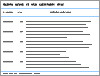
Tab.1
Classification of childhood condylar fracture"
| 分类标准 | 类别 |
|---|---|
| 骨折线位置 | 高位骨折(又称囊内骨折或髁头骨折)、中位骨折(髁颈骨折)、低位骨折(髁突基部骨折)、垂直向骨折 |
| 骨折片移位或脱位的方向 | 无移位、骨折线偏斜(骨折断端未脱离接触)、移位(骨折断端无接触但髁突仍位于关节窝内)、脱位(髁突脱离关节窝) |
| 是否伴发其他部位骨折 | 单纯髁突骨折、伴下颌骨其他部位骨折、伴其他面部骨折 |
| 侧别 | 单侧髁突骨折、双侧髁突骨折 |
| [1] |
Kozakiewicz M, Walczyk A. Current frequency of mandibular condylar process fractures[J]. J Clin Med, 2023, 12(4): 1394.
doi: 10.3390/jcm12041394 |
| [2] |
Rostyslav Y, Yakovenko L, Irina P. Fractures of the lower jaw in children(causes, types, diagnosis and treatment): Retrospective 5 year analysis[J]. J Oral Biol Craniofac Res, 2020, 10(2): 1-5.
doi: 10.1016/j.jobcr.2020.01.004 pmid: 32025479 |
| [3] |
Bottini GB, Hitzl W, Götzinger M, et al. Management of mandibular condyle fractures in pediatric patients: A multicentric retrospective study with 180 children and adolescents[J]. J Clin Med, 2024, 13(18): 5455.
doi: 10.3390/jcm13185455 |
| [4] | Yesantharao PS, Lopez J, Reategui A, et al. Combined symphyseal and condylar fractures: Considerations for treatment in growing pediatric patients[J]. Plast Reconstr Surg, 2021, 148(1): 51e-62e. |
| [5] |
Roychoudhury A. Undiagnosed pediatric condylar fractures and ankylosis of the temporomandibular joint[J]. Natl J Maxillofac Surg, 2014, 5(2): 107-108.
doi: 10.4103/0975-5950.154807 |
| [6] | Liu M, Zhao Y, He Y, et al. Outcomes of anterior disc displacement and condylar remodelling for sagittal fracture of the mandibular condyle in children after closed treatment[J]. Int J Oral Maxillofac Surg, 2020, 49(1): 82-89. |
| [7] |
Hayashi H, Fujita T, Shirakura M, et al. Role of articular disc in condylar regeneration of the mandible[J]. Exp Anim, 2014, 63(4): 395-401.
doi: 10.1538/expanim.14-0015 |
| [8] |
Fang W, Friis TE, Long X, et al. Expression of chondromodulin-1 in the temporomandibular joint condylar cartilage and disc[J]. J Oral Pathol Med, 2010, 39(4): 356-360.
doi: 10.1111/j.1600-0714.2009.00831.x pmid: 19903245 |
| [9] |
Yadav P, Bhutia O, Bansal A, et al. Does closed treatment of paediatric mandibular condyle fractures result in restitutional remodelling?[J]. Br J Oral Maxillofac Surg, 2021, 59(7): 798-806.
doi: 10.1016/j.bjoms.2021.01.016 pmid: 34272113 |
| [10] |
Ghasemzadeh A, Mundinger GS, Swanson EW, et al. Treatment of pediatric condylar fractures: A 20-year experience[J]. Plast Reconstr Surg, 2015, 136(6): 1279-1288.
doi: 10.1097/PRS.0000000000001811 pmid: 26595021 |
| [11] |
Bottini GB, Roccia F, Sobrero F. Management of pediatric mandibular condyle fractures: A literature review[J]. J Clin Med, 2024, 13(22): 6921.
doi: 10.3390/jcm13226921 |
| [12] | 王航, 王耀钟, 安金刚. 儿童髁突囊内骨折两种保守治疗方法的近期疗效评价[J]. 中华口腔医学杂志, 2024, 59(10): 1008-1013. |
| [13] |
Lee KC, Reynolds R, Recker MJ, et al. Rigid fixation of the pediatric facial skeleton[J]. Oral Maxillofac Surg Clin North Am, 2023, 35(4): 529-541.
doi: 10.1016/j.coms.2023.04.003 |
| [14] | Dai J, Gong C, Diarra D, et al. Outcomes of removing the fracture fragments in the treatment of intracapsular condylar fractures in children[J]. Med Oral Patol Oral Cir Bucal, 2025, 30(4): e536-e542. |
| [15] | Chang SP, Yang Y, Liu Y, et al. How does the remodeling capacity of children affect the morphologic changes of fractured mandibular condylar processes after conservative treatment?[J]. J Oral Maxillofac Surg, 2018, 76(6): 1279. e1-1279.e7. |
| [16] |
Zhu YF, Zou Y, Wang SZ, et al. Three-dimensional evaluation of condylar morphology after closed treatment of unilateral intracapsular condylar fracture in children and adolescents[J]. J Craniomaxillofac Surg, 2020, 48(3): 286-292.
doi: S1010-5182(20)30023-8 pmid: 32070660 |
| [17] |
Cleveland CN, Kelly A, DeGiovanni J, et al. Maxillofacial trauma in children: Association between age and mandibular fracture site[J]. Am J Otolaryngol, 2021, 42(2): 102874.
doi: 10.1016/j.amjoto.2020.102874 |
| [18] |
Yang RC, Cui MJ, Zhou HH, et al. Fracture fragment of the condyle determines the ramus height of the mandible in children with intracapsular condylar fractures treated conservatively[J]. Sci Rep, 2022, 12(1): 19924.
doi: 10.1038/s41598-022-24463-4 |
| [19] |
Vanpoecke J, Dubron K, Politis C. Condylar fractures: An argument for conservative treatment[J]. Craniomaxillofac Trauma Reconstr, 2020, 13(1): 23-31.
doi: 10.1177/1943387520902881 pmid: 32642028 |
| [20] |
MacLennan WD. Consideration of 180 cases of typical fractures of the mandibular condylar process[J]. Br J Plast Surg, 1952, 5(2): 122-128.
pmid: 14944782 |
| [21] |
Malinge M, Grimaud F, Perrin JP, et al. Outcomes of functional treatment of condylar mandibular fractures with an articular impact: A retrospective study of 108 children[J]. J Stomatol Oral Maxillofac Surg, 2022, 123(2): 177-183.
doi: 10.1016/j.jormas.2021.06.016 |
| [22] | Sabbagh H, Nikolova T, Kakoschke SC, et al. Functional orthodontic treatment of mandibular condyle fractures in children and adolescent patients: An MRI follow-up[J]. Life(Basel), 2022, 12(10): 1596. |
| [23] |
Neff A, Chossegros C, Blanc JL, et al. Position paper from the IBRA symposium on surgery of the head: The 2nd international symposium for condylar fracture osteosynthesis, Marseille, France 2012[J]. J Craniomaxillofac Surg, 2014, 42(7): 1234-1249.
doi: 10.1016/j.jcms.2014.03.005 |
| [24] |
Cooney M, O’Connell JE, Vesey JA, et al. Non-surgical management of paediatric and adolescent mandibular condyles: A retrospective review of 49 consecutive cases treated at a tertiary referral centre[J]. J Craniomaxillofac Surg, 2020, 48(7): 666-671.
doi: S1010-5182(20)30125-6 pmid: 32505527 |
| [25] |
Esposito NR, Cisternas IN, Gonzalez AC. Surgical treatment of paediatric fractures of the mandibular condyle: A systematic review of the literature[J]. Br J Oral Maxillofac Surg, 2024, 62(2): 101-104.
doi: 10.1016/j.bjoms.2023.10.015 |
| [26] |
Du CX, Xu B, Zhu YF, et al. Radiographic evaluation in three dimensions of condylar fractures with closed treatment in children and adolescents[J]. J Craniomaxillofac Surg, 2021, 49(9): 830-836.
doi: 10.1016/j.jcms.2021.04.002 pmid: 34218975 |
| [27] | Kakran A, Singhal R, Namdev R, et al. Management of pediatric mandibular fractures using orthodontic archwires and elastic traction: An alternative to conventional treatment methods[J]. Int J Clin Pediatr Dent, 2023, 16(6): 864-867. |
| [28] |
Li MX, Xing X, Li ZB, et al. Classification and treatment strategies for condylar fractures in children[J]. Br J Oral Maxillofac Surg, 2021, 59(7): 776-782.
doi: 10.1016/j.bjoms.2020.09.016 |
| [29] |
Sobrero F, Roccia F, Galetta G, et al. Pediatric mandibular fractures: Surgical management and outcomes in the deciduous, mixed and permanent dentitions[J]. Dent Traumatol, 2023, 39(3): 233-239.
doi: 10.1111/edt.12814 pmid: 36606623 |
| [30] |
Hwang K, Ma SH. Change of the inclination angle in a greenstick fracture of the mandibular subcondyle treated with intermaxillary fixation in a child[J]. J Craniofac Surg, 2021, 32(5): e504-e506.
doi: 10.1097/SCS.0000000000007461 pmid: 33741875 |
| [31] |
Vesnaver A. Dislocated pediatric condyle fractures: Should conservative treatment always be the rule?[J]. J Craniomaxillofac Surg, 2020, 48(10): 933-941.
doi: 10.1016/j.jcms.2020.08.001 pmid: 32919835 |
| [32] | 闫凯欣, 李茂叶, 常欣楠, 等. 346例未成年颌面部骨折患者的临床分析[J]. 华西口腔医学杂志, 2024, 42(3): 340-345. |
| [33] |
Minervini G, Franco R, Marrapodi MM, et al. Conservative treatment of temporomandibular joint condylar fractures: A systematic review conducted according to PRISMA guidelines and the Cochrane Handbook for Systematic Reviews of Interventions[J]. J Oral Rehabil, 2023, 50(9): 886-893.
doi: 10.1111/joor.13497 pmid: 37191365 |
| [34] |
Naik K, Lee KC, Torroni A. Does open reduction and internal fixation provide a quality-of-life benefit over traditional closed reduction of mandibular condyle fractures?[J]. J Oral Maxillofac Surg, 2020, 78(11): 2018-2026.
doi: 10.1016/j.joms.2020.07.014 |
| [35] |
Sasaki R, Nagahama R, Okamoto T. Unilateral surgical treatment of severe deviated condylar base fracture in pediatric bilateral condylar fracture: 12-Year follow-up[J]. J Craniofac Surg, 2025, 36(1): e22-e25.
doi: 10.1097/SCS.0000000000010689 |
| [36] | 韩晶, 李智, 周海华, 等. 儿童髁突骨折治疗方法的临床评价与分析[J]. 中华口腔医学杂志, 2014, 49(8): 486-490. |
| [37] |
Kamath AT, Roy S, Pai D. Paediatric condylar trauma-primary management considerations: A review[J]. J Oral Biol Craniofac Res, 2023, 13(2): 236-242.
doi: 10.1016/j.jobcr.2023.01.011 |
| [38] |
Xu JY, Zhou HH, Lv K, et al. Serious condylar head absorption in children with intracapsular condylar fractures treated operatively with long screws[J]. J Craniofac Surg, 2023, 34(2): 658-662.
doi: 10.1097/SCS.0000000000009023 |
| [39] |
Abdelazeem MH, Aboelela S, Erdogan O. Transoral endoscopic-assisted reduction and internal fixation of mandibular condylar fractures in children[J]. J Oral Maxillofac Surg, 2023, 81(5): 566-574.
doi: 10.1016/j.joms.2023.01.014 |
| [40] |
Zhang B, Liu ZH, Li J, et al. Open reduction and internal fixation of severely dislocated fractures of condylar neck and base using bioabsorbable miniplate in children: A 3-10 years follow-up study[J]. Int J Pediatr Otorhinolaryngol, 2014, 78(11): 1987-1992.
doi: 10.1016/j.ijporl.2014.09.004 |
| [41] |
Zhou HH, Lv K, Yang RT, et al. Mandibular condylar fractures in children and adolescents: 5-Year retrospective cohort study[J]. Int J Pediatr Otorhinolaryngol, 2019, 119: 113-117.
doi: 10.1016/j.ijporl.2019.01.025 |
| [42] |
Zhou HH, Lv K, Yang RT, et al. Extracapsular condylar fractures treated conservatively in children: Mechanism of bone remodelling[J]. J Craniofac Surg, 2021, 32(4): 1440-1444.
doi: 10.1097/SCS.0000000000007237 |
| [43] | 张益, 贺洋. 对创伤性颞下颌关节强直发生与分类治疗的几点认识[J]. 中华口腔医学杂志, 2023, 58(10): 985-990. |
| Viewed | ||||||
|
Full text |
|
|||||
|
Abstract |
|
|||||
