
Stomatology ›› 2026, Vol. 46 ›› Issue (9): 658-662.doi: 10.13591/j.cnki.kqyx.2026.09.003
• Basic and Clinical Research • Previous Articles Next Articles
ZHANG Hengguo( ), PAN Yufei, WANG Guoqiang, SUN Xiaoxi
Received:2026-04-20
Online:2026-09-28
Published:2026-09-20
CLC Number:
ZHANG Hengguo, PAN Yufei, WANG Guoqiang, SUN Xiaoxi. Analysis of jaw bone CBCT based on motion blur modeling and inverse filtering enhancement[J]. Stomatology, 2026, 46(9): 658-662.
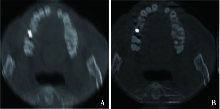
Fig.1
Effect of inverse filtering for processing CBCT motion-blurred images"

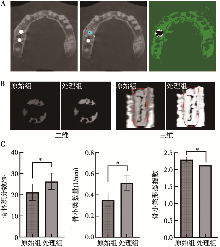
Fig.2
Bone microstructure parameters of CBCT after inverse filtering processing"

| [1] | 杨晨露, 李谨, 吴大明. CBCT在牙体牙髓诊治中的应用[J]. 口腔医学, 2017, 37(12): 1144-1147. |
| [2] | 高静, 申静. 根尖周病中锥形束CT与根尖片识别病损差异的研究进展[J]. 华西口腔医学杂志, 2015, 33(2): 209-213. |
| [3] |
李刚. 口腔颌面锥形束CT在根折诊断中的应用[J]. 口腔疾病防治, 2023, 31(10): 685-691.
doi: 10.12016/j.issn.2096-1456.2023.10.001 |
| [4] |
Guerrero ME, Jacobs R, Loubele M, et al. State-of-the-art on cone beam CT imaging for preoperative planning of implant placement[J]. Clin Oral Investig, 2006, 10(1): 1-7.
doi: 10.1007/s00784-005-0031-2 |
| [5] |
Bornstein MM, Horner K, Jacobs R. Use of cone beam computed tomography in implant dentistry: Current concepts, indications and limitations for clinical practice and research[J]. Periodontol 2000, 2017, 73(1): 51-72.
doi: 10.1111/prd.12161 pmid: 28000270 |
| [6] | 王晓华, 刘艾芃, 邓文正. 数字化导板在口腔种植中的研究进展[J]. 华西口腔医学杂志, 2020, 38(1): 95-100. |
| [7] |
陈佳君, 薛超然, 王沛棋, 等. 正畸治疗中利用锥形束CT测量牙根位置方法的研究进展[J]. 口腔疾病防治, 2022, 30(10): 740-745.
doi: 10.12016/j.issn.2096-1456.2022.10.009 |
| [8] | 奚祺, 吴国锋. 数字化口内扫描技术的发展与应用[J]. 实用口腔医学杂志, 2021, 37(1): 136-140. |
| [9] | 赵一姣, 王勇. 数字化技术在口腔医学的临床应用现状与分析[J]. 四川大学学报(医学版), 2024, 55(1): 101-110. |
| [10] |
熊佳璧, 孙为, 施斌. 口腔种植治疗中的数字化数据采集技术[J]. 中国口腔种植学杂志, 2021, 26(2): 114-119.
doi: 10.12337/zgkqzzxzz.2021.04.007 |
| [11] | 满毅. 数字化技术在口腔种植修复中的应用[J]. 口腔医学, 2017, 37(7): 577-582. |
| [12] |
Kaaber L, Matzen LH, Schropp L, et al. Low-dose CBCT protocols in implant dentistry: A systematic review[J]. Oral Surg Oral Med Oral Pathol Oral Radiol, 2024, 138(3): 427-439.
doi: 10.1016/j.oooo.2024.03.013 |
| [13] |
Schulze R, Heil U, Groβ D, et al. Artefacts in CBCT: A review[J]. Dentomaxillofacial Radiol, 2011, 40(5): 265-273.
doi: 10.1259/dmfr/30642039 |
| [14] |
Schulze RKW, Berndt D, D’Hoedt B. On cone-beam computed tomography artifacts induced by titanium implants[J]. Clin Oral Implants Res, 2010, 21(1): 100-107.
doi: 10.1111/clr.2010.21.issue-1 |
| [15] |
Terrabuio BR, Carvalho CG, Peralta-Mamani M, et al. Cone-beam computed tomography artifacts in the presence of dental implants and associated factors: An integrative review[J]. Imaging Sci Dent, 2021, 51(2): 93.
doi: 10.5624/isd.20200320 pmid: 34235055 |
| [16] | Parsa A, Ibrahim N, Hassan B, et al. Bone quality evaluation at dental implant site using multislice CT, micro-CT, and cone beam CT[J]. Clin Oral Implants Res, 2015, 26(1): e1-e7. |
| [17] |
Van Dessel J, Huang Y, Depypere M, et al. A comparative evaluation of cone beam CT and micro-CT on trabecular bone structures in the human mandible[J]. Dentomaxillofacial Radiol, 2013, 42(8): 20130145.
doi: 10.1259/dmfr.20130145 |
| [18] | 朱一帆. 基于逆滤波、维纳滤波算法的图像复原技术的研究[J]. 中国新通信, 2018, 20(6): 238. |
| [19] | 刘峰. 逆滤波在消除磁共振图像运动伪影中的仿真和应用研究[J]. 科技创新导报, 2013, 10(19): 6-8. |
| [20] | 吴雪垠, 吴谨, 张鹤. 逆滤波法在图像复原中的应用[J]. 信息技术, 2011(10): 183-185. |
| [21] |
Nicolielo LFP, Van Dessel J, van Lenthe GH, et al. Computer-based automatic classification of trabecular bone pattern can assist radiographic bone quality assessment at dental implant site[J]. Br J Radiol, 2018, 91(1092): 20180437.
doi: 10.1259/bjr.20180437 |
| [22] |
Joda T, Gallucci GO. The virtual patient in dental medicine[J]. Clin Oral Implants Res, 2015, 26(6): 725-726.
doi: 10.1111/clr.2015.26.issue-6 |
| [23] |
Li JY, Sommer C, Wang HL, et al. Creating a virtual patient for completely edentulous computer-aided implant surgery: A dental technique[J]. J Prosthet Dent, 2021, 125(4): 564-568.
doi: 10.1016/j.prosdent.2020.02.026 pmid: 32376032 |
| [24] |
An XY, Yang HW, Choi BH. Digital workflow for computer-guided implant surgery in edentulous patients with an intraoral scanner and old complete denture[J]. J Prosthodont, 2019, 28(6): 715-718.
doi: 10.1111/jopr.13073 pmid: 31087422 |
| [25] |
Panchal N, Mahmood L, Retana A, et al. Dynamic navigation for dental implant surgery[J]. Oral Maxillofac Surg Clin N Am, 2019, 31(4): 539-547.
doi: 10.1016/j.coms.2019.08.001 |
| [26] |
Jorba-García A, González-Barnadas A, Camps-Font O, et al. Accuracy assessment of dynamic computer-aided implant placement: A systematic review and meta-analysis[J]. Clin Oral Investig, 2021, 25(5): 2479-2494.
doi: 10.1007/s00784-021-03833-8 |
| [27] |
Pellegrino G, Ferri A, Del Fabbro M, et al. Dynamic navigation in implant dentistry: A systematic review and meta-analysis[J]. Int J Oral Maxillofac Implants, 2021, 36(5): e121-e140.
doi: 10.11607/jomi.8770 pmid: 34698720 |
| [28] |
Zhang Z, Xu M. A sharpness-optimized partitioned PSF estimation method for UAV TDI push-broom image deblurring[J]. Sensors, 2026, 26(8): 2414.
doi: 10.3390/s26082414 |
| [29] | Tahmaseb A, Wu V, Wismeijer D, et al. The accuracy of static computer-aided implant surgery: A systematic review and meta-analysis[J]. Clin Oral Implants Res, 2018, 29(Suppl 16): 416-435. |
| [30] | 李晋蒙, 欧国敏. 计算机辅助设计种植导板精确性及其影响因素[J]. 华西口腔医学杂志, 2017, 35(1): 93-98. |
| [31] | 李璐欣, 刘红红, 陈佳, 等. 数字化方法测量种植体周围骨嵴上软组织高度可行性分析[J]. 华西口腔医学杂志, 2023, 41(4): 426-433. |
| [32] |
陈江. 机器人在口腔种植领域的应用[J]. 中国口腔种植学杂志, 2022, 27(5): 274-279.
doi: 10.12337/zgkqzzxzz.2022.10.003 |
| [33] |
陈江, 宿玉成, 沈国芳, 等. 口腔种植机器人临床应用的专家共识(第一版)[J]. 中国口腔种植学杂志, 2023, 28(3): 134-139.
doi: 10.12337/zgkqzzxzz.2023.06.002 |
| [34] |
徐淑兰, 李平. 机器人辅助口腔种植体植入术: 机遇与挑战[J]. 中国口腔种植学杂志, 2023, 28(3): 140-145.
doi: 10.12337/zgkqzzxzz.2023.06.003 |
| [35] | 靳能皓, 乔波, 朱亮, 等. 口内扫描配准种植机器人在种植牙手术中的应用[J]. 华西口腔医学杂志, 2024, 42(6): 804-809. |
| [36] |
Kulah K, Gulsahi A, Kamburoğlu K, et al. Evaluation of maxillary trabecular microstructure as an indicator of implant stability by using 2 cone beam computed tomography systems and micro-computed tomography[J]. Oral Surg Oral Med Oral Pathol Oral Radiol, 2019, 127(3): 247-256.
doi: 10.1016/j.oooo.2018.11.014 |
| Viewed | ||||||
|
Full text |
|
|||||
|
Abstract |
|
|||||
