
Stomatology ›› 2025, Vol. 45 ›› Issue (12): 895-900.doi: 10.13591/j.cnki.kqyx.2025.12.003
• Basic and Clinical Research • Previous Articles Next Articles
QIAN Yi1,2,3, YANG Yi2,3,4,5, BI Xiaoming1,2,3, XU Jiya1,2,3, WANG Zhifang1,2,3, WANG Yueqiu6, LIU Mei1,2,3( )
)
Received:2025-03-19
Online:2025-12-28
Published:2025-12-16
Contact:
LIU Mei
E-mail:liumei2017@njmu.edu.cn
CLC Number:
QIAN Yi, YANG Yi, BI Xiaoming, XU Jiya, WANG Zhifang, WANG Yueqiu, LIU Mei. Three-dimensional finite element analysis of implant-supported prostheses and natural adjacent teeth in the aesthetic zone under different occlusal relationships[J]. Stomatology, 2025, 45(12): 895-900.
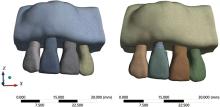
Fig.1
Three-dimensional finite element models after meshing"
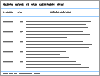
Tab.1
Material properties"
| 材料 | 弹性模量/MPa | 泊松比 |
|---|---|---|
| 皮质骨 | 1.37×10⁴ | 0.30 |
| 松质骨 | 1.37×10³ | 0.30 |
| 牙体组织 | 1.86×10⁴ | 0.31 |
| 牙周膜 | 68.90 | 0.45 |
| 种植体(钛) | 1.10×10⁵ | 0.35 |
| 基台(钛) | 1.10×10⁵ | 0.35 |
| 氧化锆全瓷冠 | 2.10×10⁵ | 0.27 |
| 螺丝(钛) | 1.10×10⁵ | 0.35 |
| 粘接层(玻璃离子水门汀) | 1.59×10⁴ | 0.33 |
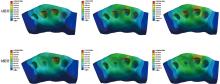
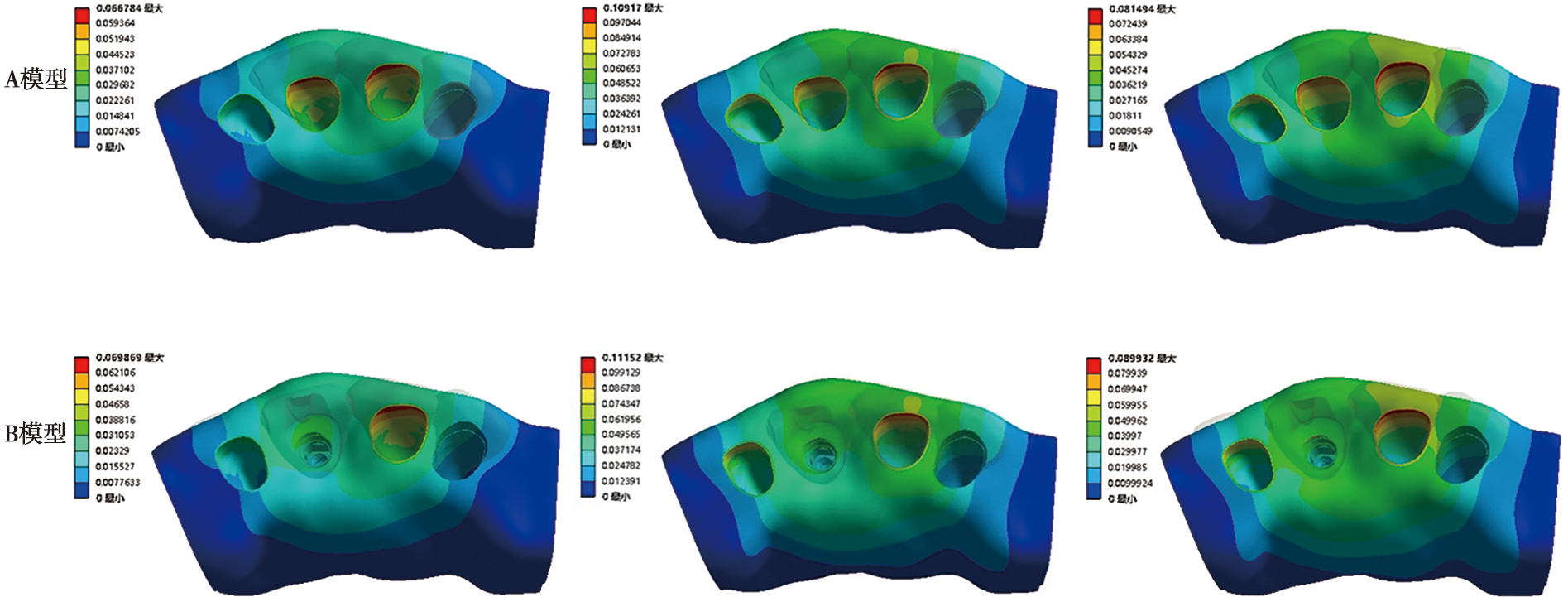
Fig.2
Cloud map of the total displacement of teeth in Model A and B under three kinds of occlusion(unit: mm)"
Tab.2
The maximum total displacement values of teeth in the two groups of models under three occlusal conditions μm"
| 咬合状态 | A模型 | B模型 | ||||
|---|---|---|---|---|---|---|
| 右上侧切牙 | 右上中切牙 | 左上中切牙 | 右上侧切牙 | 种植义齿 | 左上中切牙 | |
| 对刃牙合 | 35.18 | 63.56 | 66.78 | 35.96 | 34.81 | 69.87 |
| 正常牙合 | 87.99 | 102.07 | 109.17 | 93.56 | 58.06 | 111.52 |
| 深覆牙合 | 63.61 | 74.73 | 81.49 | 72.67 | 48.35 | 89.93 |
Tab.3
The displacement of the mesiodistal contact points between the right maxillary central incisor and adjacent teeth in Model A and Model B along the X-axis and Y-axis μm"
| 模型 | 邻接点 | 对刃牙合 | 正常牙合 | 深覆牙合 | |||||||||
|---|---|---|---|---|---|---|---|---|---|---|---|---|---|
| X轴 | Y轴 | X轴 | Y轴 | X轴 | Y轴 | ||||||||
| A模型 | 右上侧切牙近中面邻接点 | -13.61 | -80.81 | -11.66 | -202.34 | -15.38 | -126.00 | ||||||
| 右上中切牙远中面邻接点 | -7.15 | -93.48 | -7.95 | -225.19 | -7.71 | -110.03 | |||||||
| 右上中切牙近中面邻接点 | -8.93 | -129.13 | -9.04 | -248.36 | -9.47 | -128.25 | |||||||
| 左上中切牙近中面邻接点 | -4.50 | -119.61 | -2.38 | -230.53 | -4.42 | -139.15 | |||||||
| B模型 | 右上侧切牙近中面邻接点 | -18.16 | -84.67 | -40.63 | -245.07 | -26.77 | -173.36 | ||||||
| 种植义齿远中面邻接点 | -5.73 | -99.30 | -6.10 | -201.26 | -4.85 | -139.78 | |||||||
| 种植义齿近中面邻接点 | -7.67 | -134.32 | -8.01 | -245.49 | -6.36 | -170.41 | |||||||
| 左上中切牙近中面邻接点 | 4.71 | -145.13 | 9.73 | -276.17 | 14.36 | -206.41 | |||||||
Tab.4
The size of the gap generated between the mesiodistal contact points of the right maxillary central incisor/implant-supported prosthesis and the adjacent teeth μm"
| 咬合 关系 | 模型 | 右上中切牙/种植义齿与 右上侧切牙间的间隙 | 右上中切牙/种植义齿与 左上中切牙间的间隙 | ||
|---|---|---|---|---|---|
| X轴 | Y轴 | X轴 | Y轴 | ||
| 对刃牙合 | A | 6.46 | 12.67 | 4.43 | 9.52 |
| B | 12.43 | 14.63 | 12.38 | 10.81 | |
| 正常牙合 | A | 3.71 | 22.85 | 6.66 | 17.83 |
| B | 34.53 | 43.81 | 17.74 | 30.69 | |
| 深覆牙合 | A | 7.67 | 15.97 | 5.05 | 10.90 |
| B | 21.92 | 33.58 | 20.72 | 36.00 | |
| [1] | Yaltirik M, Gökçen-Röhlig B, Ozer S, et al. Clinical evaluation of small diameter straumann implants in partially edentulous patients: A 5-year retrospective study[J]. J Dent (Tehran), 2011, 8(2): 75-80. |
| [2] | Manea A, Bran S, Dinu C, et al. Principles of biomechanics in oral implantology[J]. Med Pharm Rep, 2019, 92(Suppl No 3): S14-S19. |
| [3] |
Göllner M, Holst A, Berthold C, et al. Noncontact intraoral measurement of force-related tooth mobility[J]. Clin Oral Investig, 2010, 14(5): 551-557.
doi: 10.1007/s00784-009-0344-7 |
| [4] |
Bernard JP, Schatz JP, Christou P, et al. Long-term vertical changes of the anterior maxillary teeth adjacent to single implants in young and mature adults. A retrospective study[J]. J Clin Periodontol, 2004, 31(11): 1024-1028.
pmid: 15491321 |
| [5] |
Ishihara H. Influence of occlusal contacts on tooth displacement[J]. Kokubyo Gakkai Zasshi, 2000, 67(4): 310-321.
pmid: 11201195 |
| [6] |
Taylor TD, Wiens J, Carr A. Evidence-based considerations for removable prosthodontic and dental implant occlusion: A literature review[J]. J Prosthet Dent, 2005, 94(6): 555-560.
doi: 10.1016/j.prosdent.2005.10.012 pmid: 16316802 |
| [7] | Roccuzzo M, Roccuzzo A, Ramanuskaite A. Papilla height in relation to the distance between bone crest and interproximal contact point at single-tooth implants: A systematic review[J]. Clin Oral Implants Res, 2018, 29(Suppl 15): 50-61. |
| [8] |
Koori H, Morimoto K, Tsukiyama Y, et al. Statistical analysis of the diachronic loss of interproximal contact between fixed implant prostheses and adjacent teeth[J]. Int J Prosthodont, 2010, 23(6): 535-540.
pmid: 21209989 |
| [9] |
Bidra AS. Nonsurgical management of inflammatory periimplant diseasecaused by food impaction: A clinical report[J]. J Prosthet Dent, 2014, 111(2): 96-100.
doi: 10.1016/j.prosdent.2013.06.017 |
| [10] |
Greenstein G, Carpentieri J, Cavallaro J. Open contacts adjacent to dental implant restorations: Etiology, incidence, consequences, and correction[J]. J Am Dent Assoc, 2016, 147(1): 28-34.
doi: 10.1016/j.adaj.2015.06.011 pmid: 26562738 |
| [11] | Pappous GC, Campbell S, Goldstein G. Risk factors contributing to interproximal contact loss between an implant crown and a natural tooth[J/OL]. J Prosthodont, (2024-11-05)[2025-03-01]. https://doi.org/10.1111/jopr.13992. |
| [12] |
Jung RE, Zembic A, Pjetursson BE, et al. Systematic review of the survival rate and the incidence of biological, technical, and aesthetic complications of single crowns on implants reported in longitudinal studies with a mean follow-up of 5 years[J]. Clin Oral Implants Res, 2012, 23(Suppl 6): 2-21.
doi: 10.1111/clr.2012.23.issue-s6 |
| [13] | 王岚. 种植修复义齿和天然邻牙生物力学的三维有限元分析[D]. 重庆: 重庆医科大学, 2022. |
| [14] |
Brune A, Stiesch M, Eisenburger M, et al. The effect of different occlusal contact situations on peri-implant bone stress: A contact finite element analysis of indirect axial loading[J]. Mater Sci Eng C Mater Biol Appl, 2019, 99: 367-373.
doi: 10.1016/j.msec.2019.01.104 |
| [15] | Lemos CAA, Verri FR, Noritomi PY, et al. Effect of bone quality and bone loss level around internal and external connection implants: A finite element analysis study[J]. J Prosthet Dent, 2021, 125(1): 137.e1-137137.e10. |
| [16] | Tsouknidas A, Giannopoulos D, Savvakis S, et al. The influence of bone quality on the biomechanical behavior of a tooth-implant fixed partial denture: A three-dimensional finite element analysis[J]. Int J Oral Maxillofac Implants, 2016, 31(6): e143-e154. |
| [17] |
De Boever JA, McCall WD Jr, Holden S, et al. Functional occlusal forces: An investigation by telemetry[J]. J Prosthet Dent, 1978, 40(3): 326-333.
doi: 10.1016/0022-3913(78)90042-2 pmid: 279679 |
| [18] |
Edmonds HM, Glowacka H. The ontogeny of maximum bite force in humans[J]. J Anat, 2020, 237(3): 529-542.
doi: 10.1111/joa.v237.3 |
| [19] | 吴越琳, 刘加荣. 三维有限元分析在口腔医学领域的研究进展[J]. 口腔医学, 2021, 41(7): 659-663. |
| [20] | 毕振宇, 刘阳, 黄文华. 有限元分析法在口腔生物力学领域的应用[J]. 解剖科学进展, 2009, 15(4): 427-431. |
| [21] | Ramoglu S, Tasar S, Gunsoy S, et al. Tooth-implant connection: A review[J]. Int Sch Res Not, 2013, 2013(1): 921645. |
| [22] | Wong ATY, Wat PYP, Pow EHN, et al. Proximal contact loss between implant-supported prostheses and adjacent natural teeth: A retrospective study[J]. Clin Oral Implants Res, 2015, 26(4): e68-71. |
| [23] | Papageorgiou SN, Eliades T, Hämmerle CHF. Frequency of infraposition and missing contact points in implant-supported restorations within natural dentitions over time: A systematic review with meta-analysis[J]. Clin Oral Implants Res, 2018, 29(Suppl 18): 309-325. |
| [24] |
Saber A, Chakar C, Mokbel N, et al. Prevalence of interproximal contact loss between implant-supported fixed prostheses and adjacent teeth and its impact on marginal bone loss: A retrospective study[J]. Int J Oral Maxillofac Implants, 2020, 35(3): 625-630.
doi: 10.11607/jomi.7926 pmid: 32406662 |
| [25] |
Jo DW, Kwon MJ, Kim JH, et al. Evaluation of adjacent tooth displacement in the posterior implant restoration with proximal contact loss by superimposition of digital models[J]. J Adv Prosthodont, 2019, 11(2): 88-94.
doi: 10.4047/jap.2019.11.2.88 |
| [26] |
Kim JH, Lee JG, Han DH, et al. Morphometric analysis of the anterior region of the maxillary bone for immediate implant placement using micro-CT[J]. Clin Anat, 2011, 24(4): 462-468.
doi: 10.1002/ca.v24.4 |
| [27] |
Yen JY, Kang L, Chou IC, et al. Risk assessment of interproximal contact loss between implant-supported fixed prostheses and adjacent teeth: A retrospective radiographic study[J]. J Prosthet Dent, 2022, 127(1): 86-92.
doi: 10.1016/j.prosdent.2020.06.023 |
| [28] |
Kurthy R. Walking forward. Closing unwanted posterior open interproximal contacts[J]. Dent Today, 2002, 21(9): 82-85.
pmid: 12271848 |
| [29] |
Stokholm R, Isidor F, Nyengaard JR. Histologic and histomorphometric evaluation of peri-implant bone of immediate or delayed occlusal-loaded non-splinted implants in the posterior mandible: An experimental study in monkeys[J]. Clin Oral Implants Res, 2014, 25(11): 1311-1318.
doi: 10.1111/clr.2014.25.issue-11 |
| [30] |
Goodacre CJ, Bernal G, Rungcharassaeng K, et al. Clinical complications with implants and implant prostheses[J]. J Prosthet Dent, 2003, 90(2): 121-132.
doi: 10.1016/S0022-3913(03)00212-9 pmid: 12886205 |
| [31] |
Schulte W. Implants and the periodontium[J]. Int Dent J, 1995, 45(1): 16-26.
pmid: 7607740 |
| [32] |
Kitamura E, Stegaroiu R, Nomura S, et al. Biomechanical aspects of marginal bone resorption around osseointegrated implants: Considerations based on a three-dimensional finite element analysis[J]. Clin Oral Implants Res, 2004, 15(4): 401-412.
doi: 10.1111/clr.2004.15.issue-4 |
| [33] |
Rilo B, da Silva JL, Mora MJ, et al. Guidelines for occlusion strategy in implant-borne prostheses. A review[J]. Int Dent J, 2008, 58(3): 139-145.
pmid: 18630109 |
| Viewed | ||||||
|
Full text |
|
|||||
|
Abstract |
|
|||||
