
Stomatology ›› 2026, Vol. 46 ›› Issue (9): 696-702.doi: 10.13591/j.cnki.kqyx.2026.09.009
• Basic and Clinical Research • Previous Articles Next Articles
HU Min1, CAI Minchun2, WANG Yuting3, FAN Wei2, WANG Siyu4, GU Qihui2, YANG Qifei5, NI Xiaoyu6, WANG Zhendong2( )
)
Received:2026-02-04
Online:2026-09-28
Published:2026-09-20
CLC Number:
HU Min, CAI Minchun, WANG Yuting, FAN Wei, WANG Siyu, GU Qihui, YANG Qifei, NI Xiaoyu, WANG Zhendong. Construction and analysis of a three-dimensional finite element model of the cranio-maxillary complex and palatal obturator in neonates with unilateral complete cleft lip and palate[J]. Stomatology, 2026, 46(9): 696-702.
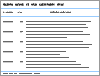
Tab.1
Elastic modulus and Poisson’s ratio for each material"
| 材料 | 弹性模量/MPa | 泊松比 |
|---|---|---|
| 牙槽骨 | 2 751.70 | 0.28 |
| 牙龈 | 37.36 | 0.45 |
| 颅缝 | 5.00 | 0.30 |
| 腭护板 | 528.00 | 0.36 |
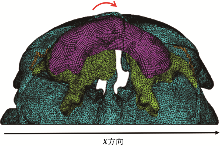
Fig.1
Schematic of palatal obturator loading conditions"

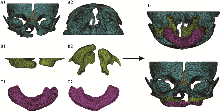
Fig.2
Schematic diagram of the combination of the cranio-maxillary complex, gingiva and palatal obturotor"

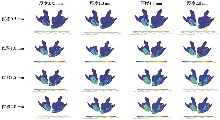
Fig.3
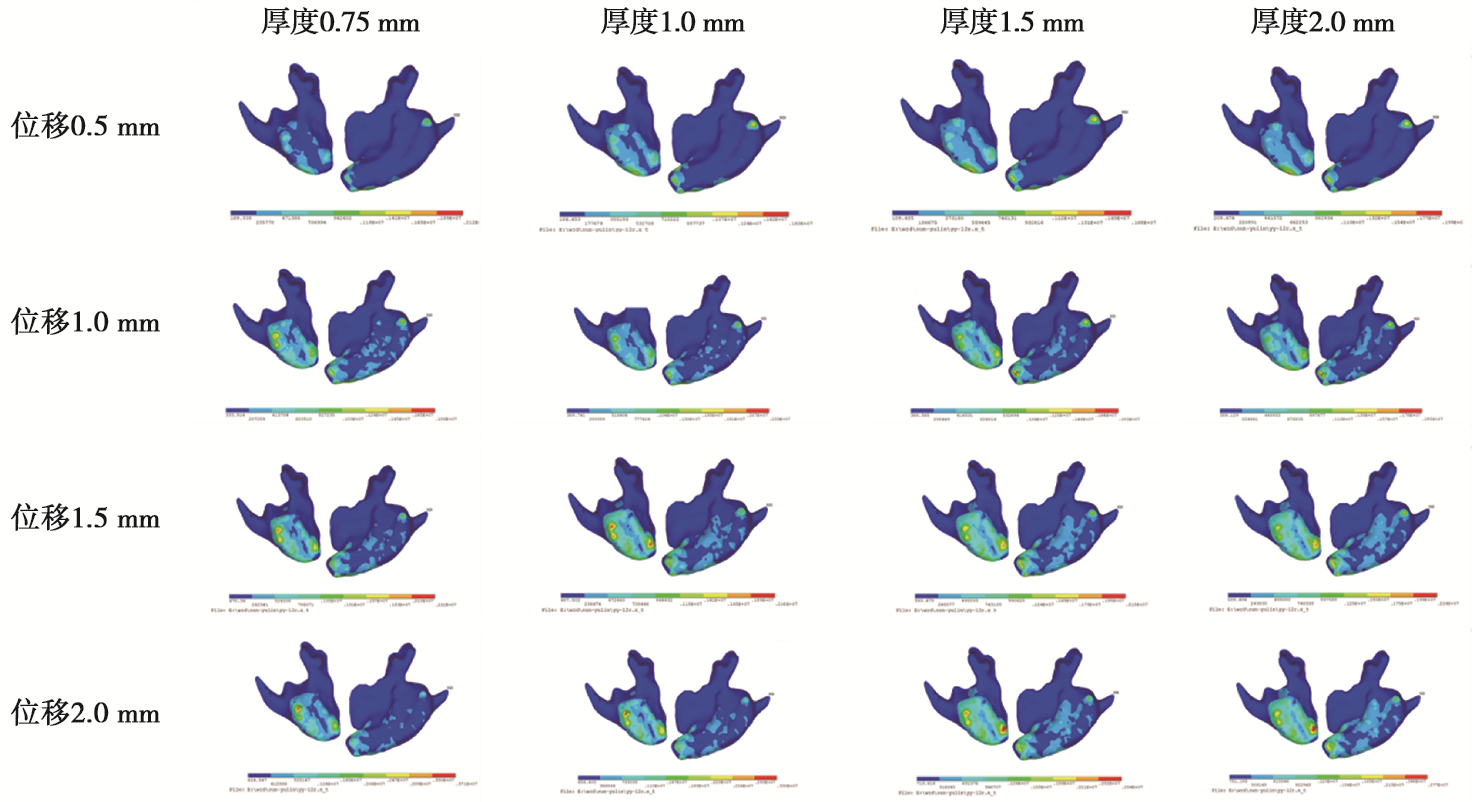
Stress distribution of the alveolar mucosa at different displacement load parameters and palatal obturator thickness"
Tab.2
Nodes and elements countin the finite element model of each component"
| 有限元模型 | 节点 | 单元数 |
|---|---|---|
| 颅-上颌复合体及骨缝 | 132 795 | 651 901 |
| 牙龈 | 22 099 | 89 302 |
| 腭护板 | 2 538 | 2 477 |
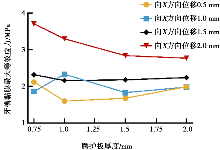
Fig.4
Changes in the maximum equivalent stress of the alveolar mucosa under different displacement load parameters and palatal obturator thicknesses"
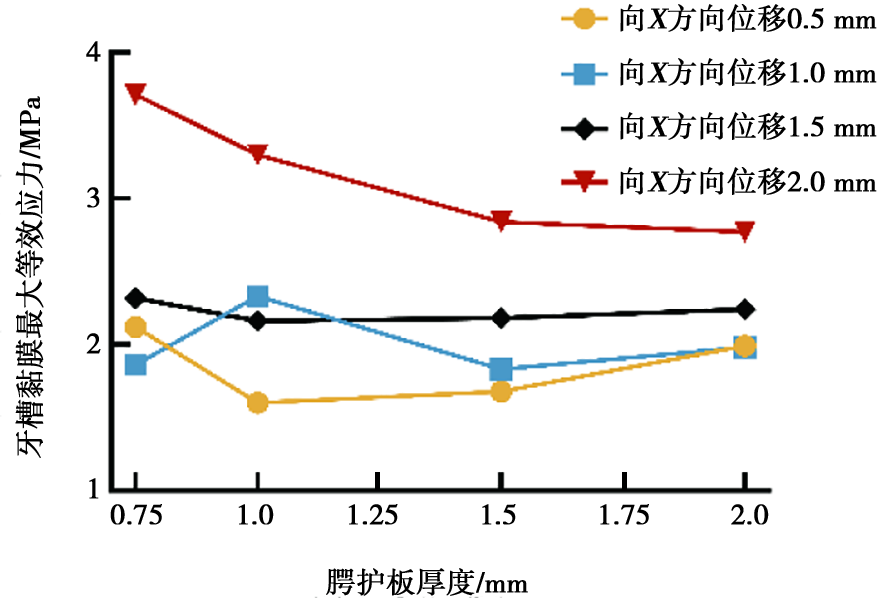
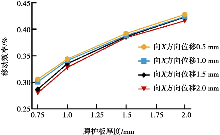
Fig.5
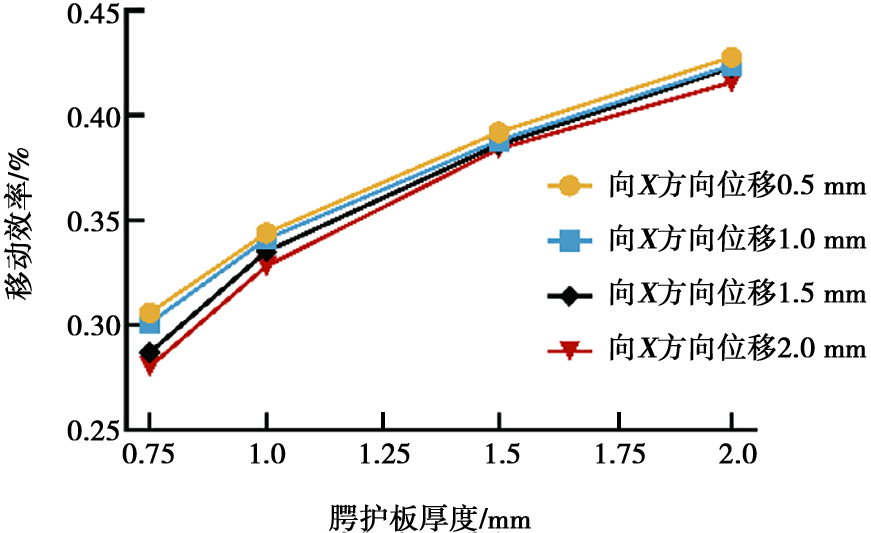
Changes in different displacement load parameters and palatal obturator thickness on the efficiency of maxillary bone movement in neonates"
| [1] |
Salari N, Darvishi N, Heydari M, et al. Global prevalence of cleft palate, cleft lip and cleft palate and lip: A comprehensive systematic review and meta-analysis[J]. J Stomatol Oral Maxillofac Surg, 2022, 123(2): 110-120.
doi: 10.1016/j.jormas.2021.05.008 |
| [2] |
Dixon MJ, Marazita ML, Beaty TH, et al. Cleft lip and palate: Understanding genetic and environmental influences[J]. Nat Rev Genet, 2011, 12(3): 167-178.
doi: 10.1038/nrg2933 pmid: 21331089 |
| [3] |
Mossey PA, Modell B. Epidemiology of oral clefts 2012: An international perspective[J]. Front Oral Biol, 2012, 16: 1-18.
doi: 10.1159/000337464 pmid: 22759666 |
| [4] | Liu JF, Zhang YL, Zhang L, et al. Orofacial clefts in high prevalence area of birth defects-five counties, Shanxi Province, China, 2000-2020[J]. China CDC Wkly, 2021, 3(37): 773-777. |
| [5] |
Mossey PA, Little J, Munger RG, et al. Cleft lip and palate[J]. Lancet, 2009, 374(9703): 1773-1785.
doi: 10.1016/S0140-6736(09)60695-4 pmid: 19747722 |
| [6] |
Xia W, Du M, Wu M, et al. Patient-reported outcomes measure for patients with cleft palate[J]. Front Public Health, 2024, 12: 1469455.
doi: 10.3389/fpubh.2024.1469455 |
| [7] |
Nguyen NH, Hall AE, Taylor JM, et al. Psychosocial functioning in patients with cleft lip and palate: A narrative review of the literature[J]. Face, 2025, 6(2): 312-321.
doi: 10.1177/27325016251327665 |
| [8] |
Kamble VD, Parkhedkar RD, Sarin SP, et al. Presurgical nasoalveolar molding(PNAM)for a unilateral cleft lip and palate: A clinical report[J]. J Prosthodont, 2013, 22(1): 74-80.
doi: 10.1111/jopr.2013.22.issue-1 |
| [9] |
Grayson BH, Santiago PE, Brecht LE, et al. Presurgical nasoalveolar molding in infants with cleft lip and palate[J]. Cleft Palate Craniofac J, 1999, 36(6): 486-498.
doi: 10.1597/1545-1569_1999_036_0486_pnmiiw_2.3.co_2 |
| [10] |
Cattaneo PM, Cornelis MA. Orthodontic tooth movement studied by finite element analysis: An update. what can we learn from these simulations?[J]. Curr Osteoporos Rep, 2021, 19(2): 175-181.
doi: 10.1007/s11914-021-00664-0 pmid: 33538966 |
| [11] |
Thresher RW, Saito GE. The stress analysis of human teeth[J]. J Biomech, 1973, 6(5): 443-449.
pmid: 4748494 |
| [12] |
Huang ST, Wei HB, Li DH. Additive manufacturing technologies in the oral implant clinic: A review of current applications and progress[J]. Front Bioeng Biotechnol, 2023, 11: 1100155.
doi: 10.3389/fbioe.2023.1100155 |
| [13] |
Bauer FX, Heinrich V, Grill FD, et al. Establishment of a finite element model of a neonate’s skull to evaluate the stress pattern distribution resulting during nasoalveolar molding therapy of cleft lip and palate patients[J]. J Craniomaxillofac Surg, 2018, 46(4): 660-667.
doi: 10.1016/j.jcms.2018.01.015 |
| [14] |
Wake N, Alexander AE, Christensen AM, et al. Creating patient-specific anatomical models for 3D printing and AR/VR: A supplement for the 2018 Radiological Society of North America(RSNA)hands-on course[J]. 3D Print Med, 2019, 5(1): 17.
doi: 10.1186/s41205-019-0054-y |
| [15] |
Gao T, Chen ZY, Li T, et al. Correlation analysis of the puncture-side bone cement/vertebral body volume ratio and bone cement leakage in the paravertebral vein in vertebroplasty[J]. BMC Musculoskelet Disord, 2022, 23(1): 184.
doi: 10.1186/s12891-022-05135-w |
| [16] |
Marques ML, da Silva NP, van der Heijde D, et al. Hounsfield Units measured in low dose CT reliably assess vertebral trabecular bone density changes over two years in axial spondyloarthritis[J]. Semin Arthritis Rheum, 2023, 58: 152144.
doi: 10.1016/j.semarthrit.2022.152144 |
| [17] |
Mahesh M. The essential physics of medical imaging, third edition[J]. Med Phys, 2013, 40(7): 077301.
doi: 10.1118/1.4811156 |
| [18] |
杨刚, 胡文杰, 曹洁, 等. 牙周健康的上颌前牙唇侧嵴顶上牙龈的三维形态分析[J]. 北京大学学报(医学版), 2021, 53(5): 990-994.
doi: 10.19723/j.issn.1671-167X.2021.05.030 |
| [19] |
Fedorov A, Beichel R, Kalpathy-Cramer J, et al. 3D Slicer as an image computing platform for the Quantitative Imaging Network[J]. Magn Reson Imaging, 2012, 30(9): 1323-1341.
doi: 10.1016/j.mri.2012.05.001 pmid: 22770690 |
| [20] |
Liu L, Song QX, Zhou J, et al. The effects of aligner overtreat-ment on torque control and intrusion of incisors for anterior retraction with clear aligners: A finite-element study[J]. Am J Orthod Dentofacial Orthop, 2022, 162(1): 33-41.
doi: 10.1016/j.ajodo.2021.02.020 |
| [21] |
Ueno D, Sato J, Igarashi C, et al. Accuracy of oral mucosal thickness measurements using spiral computed tomography[J]. J Periodontol, 2011, 82(6): 829-836.
doi: 10.1902/jop.2010.100160 pmid: 21073331 |
| [22] |
Dupaix RB, Boyce MC. Finite strain behavior of poly(ethylene terephthalate) (PET) and poly (ethylene terephthalate)-glycol (PETG)[J]. Polymer, 2005, 46(13): 4827-4838.
doi: 10.1016/j.polymer.2005.03.083 |
| [23] | 王如意, 赵志河, 李宇. 正畸用热压膜材料现状与展望[J]. 华西口腔医学杂志, 2018, 36(1): 87-91. |
| [24] |
Kinikoglu B, Damour O, Hasirci V. Tissue engineering of oral mucosa: A shared concept with skin[J]. J Artif Organs, 2015, 18(1): 8-19.
doi: 10.1007/s10047-014-0798-5 pmid: 25326194 |
| [25] |
Alisha KH, Batra P, Juneja A, et al. 3-Dimensional evaluation of two PNAM techniques(Modified Grayson & AlignerNAM)on facial soft tissue morphology: A randomised clinical trial[J]. Cleft Palate Craniofac J, 2025, 62(7): 1114-1126.
doi: 10.1177/10556656241246923 |
| [26] | Lin JH, Wu GL, Chiu CK, et al. Finite element analysis model for assessing expansion patterns from surgically assisted rapid palatal expansion[J]. JoVE, 2023(200): e65994. |
| [27] |
Ahmida A, Mehta S, Amelemah E, et al. Short-term and long-term effects of miniscrew-assisted and conventional rapid palatal expansion on the cranial and circummaxillary sutures[J]. Am J Orthod Dentofacial Orthop, 2023, 163(4): e115-e126.
doi: 10.1016/j.ajodo.2023.01.007 |
| [28] |
Ghoneima A, Abdel-Fattah E, Hartsfield J, et al. Effects of rapid maxillary expansion on the cranial and circummaxillary sutures[J]. Am J Orthod Dentofacial Orthop, 2011, 140(4): 510-519.
doi: 10.1016/j.ajodo.2010.10.024 |
| [29] |
Eley KA, Sheerin F, Taylor N, et al. Identification of normal cranial sutures in infants on routine magnetic resonance imaging[J]. J Craniofac Surg, 2013, 24(1): 317-320.
doi: 10.1097/SCS.0b013e318275edee pmid: 23348309 |
| [30] |
Antonio VJ, César GF, Héctor F, et al. Biomechanical applications of finite element analysis in orthodontics: A scoping review of force distribution, tooth movement, and mechanical performance[J]. Dent J, 2026, 14(3): 148.
doi: 10.3390/dj14030148 |
| [31] |
Badiee RK, Cordero DM, Tse RW, et al. Multidisciplinary care considerations for children with facial clefts[J]. Oral Maxillofac Surg Clin N Am, 2026, 38(2): 159-176.
doi: 10.1016/j.coms.2025.12.001 |
| [32] |
潘维伟, 童笑梅. 非综合征型颅缝早闭症术后矫形头盔治疗45例病例系列报告[J]. 中国循证儿科杂志, 2023, 18(1): 62-65.
doi: 10.3969/j.issn.1673-5501.2023.01.010 |
| Viewed | ||||||
|
Full text |
|
|||||
|
Abstract |
|
|||||
