
Stomatology ›› 2026, Vol. 46 ›› Issue (1): 61-65.doi: 10.13591/j.cnki.kqyx.2026.01.010
• Basic and Clinical Research • Previous Articles Next Articles
CHEN Yan, WANG Mengting, SHI Fan, TANG Jinxin, XUE Chang’ao, SONG Xin( )
)
Received:2025-05-07
Online:2026-01-28
Published:2026-01-16
Contact:
SONG Xin
E-mail:songxin623@163.com
CLC Number:
CHEN Yan, WANG Mengting, SHI Fan, TANG Jinxin, XUE Chang’ao, SONG Xin. The clinical effect of ICam4D photogrammetry technology applied in the fixed restoration of oral implants[J]. Stomatology, 2026, 46(1): 61-65.
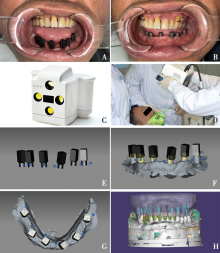
Fig.1
Scanning and design"
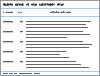
Tab.1
Evaluation criteria for the suitability of prosthesis edges"
 |
Tab.2
Patient basic information"
| 组别 | n | 年龄/岁 | 性别(男/女) |
|---|---|---|---|
| ICam4D组 | 16 | 56.47±8.59 | 10/6 |
| 夹板组 | 15 | 60.38±9.67 | 8/7 |
| 开窗组 | 15 | 58.10±12.36 | 9/6 |
| 统计值 | F=0.561 | χ2=0.814 | |
| P | 0.574 | 0.706 |
Tab.3
Fitness conditions for prosthesis edges"
| 组别 | n | Ⅰ | Ⅱ | Ⅲ |
|---|---|---|---|---|
| ICam4D组 | 16 | 16 | 0 | 0 |
| 夹板组 | 15 | 14 | 1 | 0 |
| 开窗组 | 15 | 14 | 1 | 0 |
Tab.4
The duration of the impression and the VAS score for the comfort and satisfaction of the restoration"
| 组别 | n | 印模时长/min | 舒适度VAS评分 | 满意度VAS评分 | |||
|---|---|---|---|---|---|---|---|
| 美观 | 咀嚼 | 发音 | 其他等总体满意度 | ||||
| ICam4D组 | 16 | 16.53±3.24 | 95.77±2.30 | 92.27±4.56 | 94.02±4.27 | 91.87±5.43 | 93.46±2.64 |
| 夹板组 | 15 | 59.38±10.74 | 60.02±7.56 | 93.48±3.23 | 90.02±4.23* | 95.24±2.36 | 92.86±3.96 |
| 开窗组 | 15 | 25.46±5.63 | 71.92±6.55 | 91.56±4.45 | 93.43±2.78 | 92.47±3.22 | 92.58±4.07 |
| F | 147.420 | 148.980 | 0.769 | 4.563 | 2.962 | 0.240 | |
| P | <0.001 | <0.001 | 0.085 | 0.054 | 0.043 | 0.150 | |
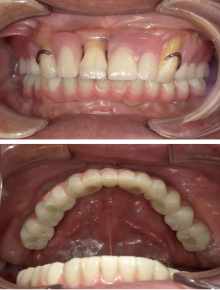
Fig.2
Final restoration"

| [1] |
顾新华. 萎缩无牙颌患者数字化种植即刻修复工作流程[J]. 口腔疾病防治, 2020, 28(12): 749-758.
doi: 10.12016/j.issn.2096-1456.2020.12.001 |
| [2] |
Papaspyridakos P, Chen CJ, Gallucci GO, et al. Accuracy of implant impressions for partially and completely edentulous patients: A systematic review[J]. Int J Oral Maxillofac Implants, 2014, 29(4): 836-845.
doi: 10.11607/jomi.3625 |
| [3] |
Di Fiore A, Meneghello R, Graiff L, et al. Full arch digital scanning systems performances for implant-supported fixed dental prostheses: A comparative study of 8 intraoral scanners[J]. J Prosthodont Res, 2019, 63(4): 396-403.
doi: S1883-1958(18)30363-3 pmid: 31072730 |
| [4] | 付馨靓, 王浩, 甘雪琦. ICam4D摄影测量技术在无牙颌种植固定修复中的应用1例并文献回顾[J]. 口腔医学, 2022, 42(1): 72-78. |
| [5] |
Chen YM, Zhai ZH, Watanabe S, et al. Understanding the effect of scan spans on the accuracy of intraoral and desktop scanners[J]. J Dent, 2022, 124: 104220.
doi: 10.1016/j.jdent.2022.104220 |
| [6] |
游杰, 闫文娟, 林丽婷, 等. 数字化口内扫描技术专家共识[J]. 口腔疾病防治, 2024, 32(8): 569-577.
doi: 10.12016/j.issn.2096-1456.2024.08.001 |
| [7] |
Kim MK, Son K, Yu BY, et al. Effect of the volumetric dimensi-ons of a complete arch on the accuracy of scanners[J]. J Adv Prosthodont, 2020, 12(6): 361-368.
doi: 10.4047/jap.2020.12.6.361 |
| [8] |
Kaewbuasa N, Ongthiemsak C. Effect of different arch widths on the accuracy of three intraoral scanners[J]. J Adv Prosthodont, 2021, 13(4): 205-215.
doi: 10.4047/jap.2021.13.4.205 pmid: 34504672 |
| [9] | 雷妍汐, 袁泉, 吕鸣樾. 立体摄影测量技术在全口种植修复印模制取中应用的文献回顾[J]. 中国口腔种植学杂志, 2024, 29(6): 590-595. |
| [10] |
Gómez-Polo M, Barmak AB, Ortega R, et al. Accuracy, scanning time, and patient satisfaction of stereophotogrammetry systems for acquiring 3D dental implant positions: A systematic review[J]. J Prosthodont, 2023, 32(S2): 208-224.
doi: 10.1111/jopr.13751 pmid: 37591510 |
| [11] |
江波, 张雪舟, 向梅, 等. 数字化印模应用于全牙弓种植固定修复的临床研究[J]. 口腔医学研究, 2019, 35(9): 906-909.
doi: 10.13701/j.cnki.kqyxyj.2019.09.021 |
| [12] | 张丹丹, 李娟, 周荣华, 等. ICam4D摄影测量技术应用于全牙弓种植固定终修复的临床研究[J]. 口腔颌面修复学杂志, 2024, 25(1): 22-27. |
| [13] | Jemt T, Hjalmarsson L. measurements of precision of fit of implant-supported frameworks. A comparison between“virtual”and“physical”assessments of fit using two different techniques of measurements[J]. Clin Implant Dent Relat Res, 2012, 14(Suppl 1): e175-182. |
| [14] |
Sánchez-Monescillo A, Hernanz-Martín J, González-Serrano C, et al. All-on-four rehabilitation using photogrammetric impression technique[J]. Quintessence Int, 2019, 50(4): 288-293.
doi: 10.3290/j.qi.a42098 pmid: 30887962 |
| [15] | 林继超, 苏恩典, 庄怡园, 等. 数字化印模在口腔种植中的应用现状[J]. 口腔医学, 2019, 39(6): 544-546. |
| [16] | 张丹丹, 周荣华, 施丽珍, 等. ICam4D摄影测量技术应用于全口种植咬合重建1例[J]. 中国临床案例成果数据库, 2023, 5(1): E00960-E00960. |
| [17] |
Revilla-León M, Att W, Özcan M, et al. Comparison of conventional, photogrammetry, and intraoral scanning accuracy of complete-arch implant impression procedures evaluated with a coordinate measuring machine[J]. J Prosthet Dent, 2021, 125(3): 470-478.
doi: 10.1016/j.prosdent.2020.03.005 pmid: 32386912 |
| [18] |
Ma BW, Yue XX, Sun YJ, et al. Accuracy of photogrammetry, intraoral scanning, and conventional impression techniques for complete-arch implant rehabilitation: An in vitro comparative study[J]. BMC Oral Health, 2021, 21(1): 636.
doi: 10.1186/s12903-021-02005-0 |
| [19] |
Gómez-Polo M, Álvarez F, Ortega R, et al. Influence of the implant scan body bevel location, implant angulation and position on intraoral scanning accuracy: An in vitro study[J]. J Dent, 2022, 121: 104122.
doi: 10.1016/j.jdent.2022.104122 |
| [20] |
Yan YW, Lin X, Yue XX, et al. Accuracy of 2 direct digital scanning techniques-intraoral scanning and stereophotogrammetry-for complete arch implant-supported fixed prostheses: A prospective study[J]. J Prosthet Dent, 2023, 130(4): 564-572.
doi: 10.1016/j.prosdent.2022.03.033 |
| [21] |
Zhang YJ, Qian SJ, Lai HC, et al. Accuracy of photogrammetric imaging versus conventional impressions for complete arch implant-supported fixed dental prostheses: A comparative clinical study[J]. J Prosthet Dent, 2023, 130(2): 212-218.
doi: 10.1016/j.prosdent.2021.09.035 |
| [22] | Alsharbaty MHM, Alikhasi M, Zarrati S, et al. A clinical comparative study of 3-dimensional accuracy between digital and conventional implant impression techniques[J]. J Prosthodont, 2019, 28(4): e902-e908. |
| Viewed | ||||||
|
Full text |
|
|||||
|
Abstract |
|
|||||
