
Stomatology ›› 2026, Vol. 46 ›› Issue (7): 514-520.doi: 10.13591/j.cnki.kqyx.2026.07.005
• Basic and Clinical Research • Previous Articles Next Articles
MU Wenqing1,2,3, LYU Ziang1,2,3, SUN Jiajun1,2,3, ZHENG Kai3( ), ZHANG Wei1,2,3()
Received:2026-02-07
Online:2026-07-28
Published:2026-07-23
CLC Number:
MU Wenqing, LYU Ziang, SUN Jiajun, ZHENG Kai, ZHANG Wei. Recombinant humanized type Ⅲ collagen coating enhances cell adhesion and osteogenic differentiation on polyetheretherketone[J]. Stomatology, 2026, 46(7): 514-520.
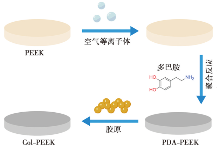
Fig.1
Schematic illustration of the coating preparation"
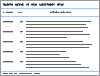
Tab.1
Primer sequences"
| 基因 | 引物序列(5'—3') |
|---|---|
| ALP | F:TCACCAGGGGGATTTTGACAC R:GGGGGTATGGAACGTCTGAG |
| OCN | F:GGCAGCGAGGTAGTGAAGAGA R:CTCCTGAAAGCCGATGTGG |
| RUNX2 | F:GACGAGGCAAGAGTTTCACC R:GGTTCCCGAGGTCCATCTAC |
| OPN | F:CTCCATTGACTCGAACGACTC R:CAGGTCTGCGAAACTTCTTAGAT |
| GAPDH | F:CAATGACCCCTTCATTGACC R:TTGATTTTGGAGGGATCTCG |
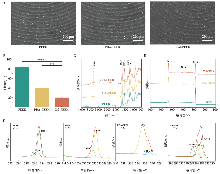
Fig.2
Surface characterization of PEEK samples with different surface modifications"
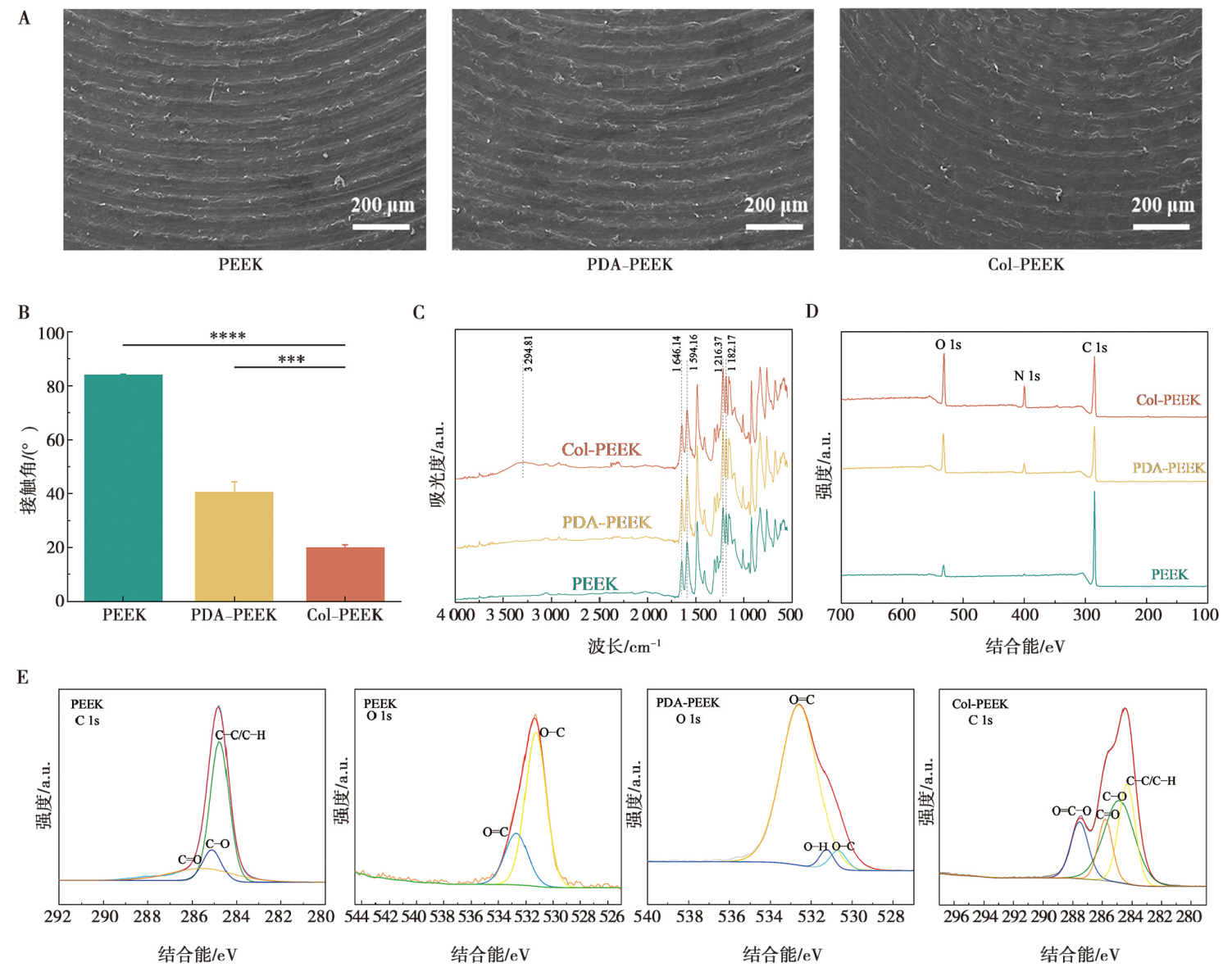
Fig.3
Effects of different PEEK samples on proliferation and adhesion of hjBMMSCs"
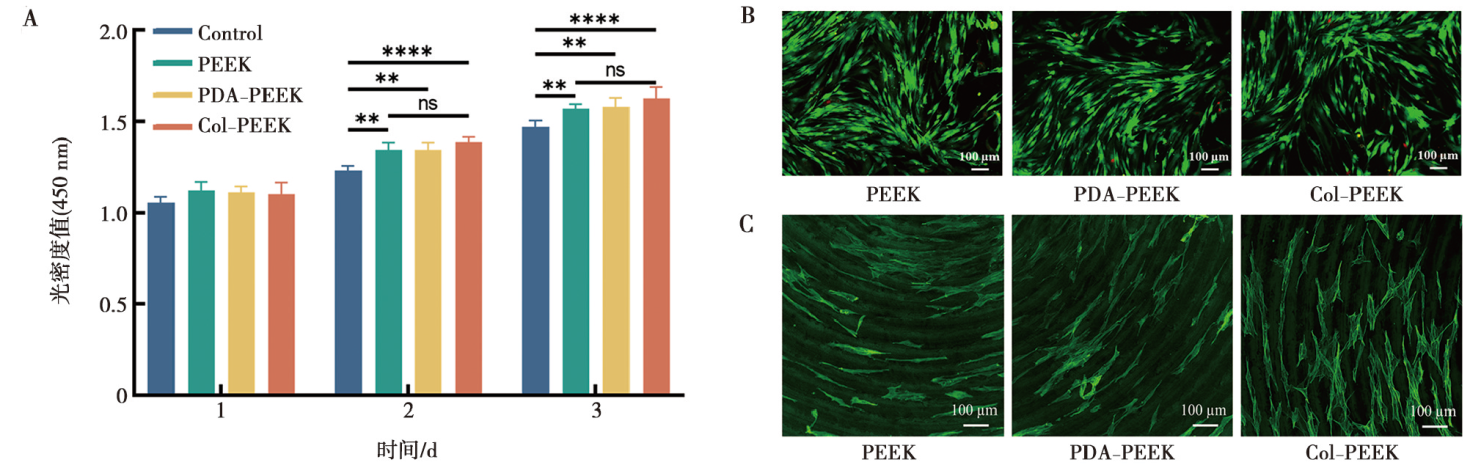
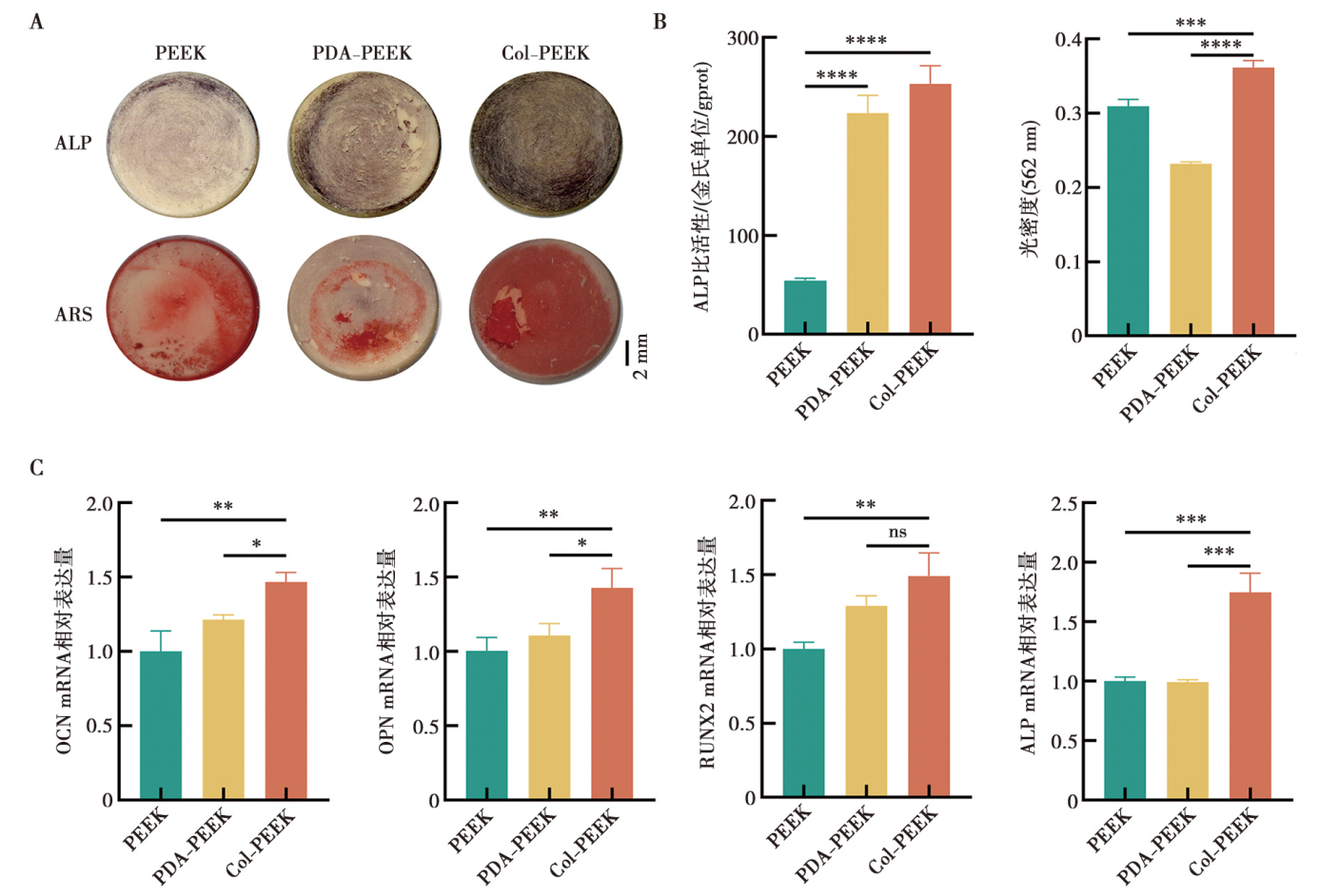
Fig.4
Effects of different PEEK samples on osteogenic differentiation of hjBMMSCs"
| [1] | Zaifman JM, Megalla M, Grace Z, et al. Orthopaedic sports injuries in an aging population: Current trends and future projections[J]. Phys Health A Multidiscip Approach, 2025, 17(6): 1192-1199. |
| [2] |
Savio D, Bagno A. When the total hip replacement fails: A review on the stress-shielding effect[J]. Processes, 2022, 10(3): 612.
doi: 10.3390/pr10030612 |
| [3] |
He MM, Huang Y, Xu H, et al. Modification of polyetheretherketone implants: From enhancing bone integration to enabling multi-modal therapeutics[J]. Acta Biomater, 2021, 129: 18-32.
doi: 10.1016/j.actbio.2021.05.009 |
| [4] |
Gu XM, Sun XL, Sun Y, et al. Bioinspired modifications of PEEK implants for bone tissue engineering[J]. Front Bioeng Biotechnol, 2021, 8: 631616.
doi: 10.3389/fbioe.2020.631616 |
| [5] | Zheng Z, Liu PJ, Zhang XM, et al. Strategies to improve bioactive and antibacterial properties of polyetheretherketone(PEEK)for use as orthopedic implants[J]. Mater Today Bio, 2022, 16: 100402. |
| [6] |
Liang XX, Li H, Hu TZ, et al. Experimental study on the effects of modification on the tribological properties of PEEK materials[J]. Polym Compos, 2026, 47(11):9955-9972.
doi: 10.1002/pc.v47.11 |
| [7] | Buck E, Li H, Cerruti M. Surface modification strategies to improve the osseointegration of poly(etheretherketone)and its composites[J]. Macromol Biosci, 2020, 20(2): e1900271. |
| [8] |
Ma TT, Zhang JJ, Sun SY, et al. Current treatment methods to improve the bioactivity and bonding strength of PEEK for dental application: A systematic review[J]. Eur Polym J, 2023, 183: 111757.
doi: 10.1016/j.eurpolymj.2022.111757 |
| [9] |
Pillai RR, Mohan L. Plasma surface modification of biomedical implants and devices: Emphasis on orthopedic, dental, and cardiovascular applications[J]. Prosthesis, 2025, 7(6): 143.
doi: 10.3390/prosthesis7060143 |
| [10] |
Fu Q, Gabriel M, Schmidt F, et al. The impact of different low-pressure plasma types on the physical, chemical and biological surface properties of PEEK[J]. Dent Mater, 2021, 37(1): e15-e22.
doi: 10.1016/j.dental.2020.09.020 pmid: 33148448 |
| [11] |
Li MS, Liu XY, Tian EK, et al. The role of collagen in mechanotransduction and its influence on bone metabolic activity[J]. Int J Biol Macromol, 2025, 318: 144968.
doi: 10.1016/j.ijbiomac.2025.144968 |
| [12] |
Chen ZY, Fan DD, Shang LJ. Exploring thepotential of the recombinant human collagens for biomedical and clinical applications: A short review[J]. Biomed Mater, 2021, 16(1): 012001.
doi: 10.1088/1748-605X/aba6fa |
| [13] |
Xu LJ, Liu YF, Tang LZ, et al. Preparation of recombinant human collagen Ⅲ protein hydrogels with sustained release of extracellular vesicles for skin wound healing[J]. Int J Mol Sci, 2022, 23(11): 6289.
doi: 10.3390/ijms23116289 |
| [14] | Yang Y, Xu RZ, Wang CJ, et al. Recombinant human collagen-based bioinks for the 3D bioprinting of full-thickness human skin equivalent[J]. Int J Bioprinting, 2022, 8(4): 611. |
| [15] |
Yang L, Wu HS, Lu L, et al. A tailored extracellular matrix(ECM)- mimetic coating for cardiovascular stents by stepwise assembly of hyaluronic acid and recombinant human type Ⅲ collagen[J]. Biomaterials, 2021, 276: 121055.
doi: 10.1016/j.biomaterials.2021.121055 |
| [16] |
Hiratsuka T, Ogura I, Okamura A, et al. Bioresorbable bone graft composed of an RGD-enriched recombinant human collagen polypeptide induced neovascularization and regeneration of mature bone tissue[J]. ACS Appl Bio Mater, 2020, 3(12): 8592-8602.
doi: 10.1021/acsabm.0c00986 pmid: 35019630 |
| [17] |
Dondani JR, Iyer J, Tran SD. Surface treatments of PEEK for osseointegration to bone[J]. Biomolecules, 2023, 13(3): 464.
doi: 10.3390/biom13030464 |
| [18] |
Huang HG, Liu X, Wang JZ, et al. Strategies to improve the performance of polyetheretherketone(PEEK)as orthopedic implants: From surface modification to addition of bioactive materials[J]. J Mater Chem B, 2024, 12(19): 4533-4552.
doi: 10.1039/D3TB02740F |
| [19] |
Rahmati M, Silva EA, Reseland JE, et al. Biological responses to physicochemical properties of biomaterial surface[J]. Chem Soc Rev, 2020, 49(15): 5178-5224.
doi: 10.1039/d0cs00103a pmid: 32642749 |
| [20] |
Wei XP, Lei LS, Luo L, et al. Advances in osteoimmunomodulation of biomaterials after intrabone implantation: Focus on surface hydrophilicity[J]. J Mater Chem B, 2024, 12(43): 11089-11104.
doi: 10.1039/D4TB01907E |
| [21] |
Arisaka Y, Masuda H, Yoda T, et al. Phototethering of collagen onto polyetheretherketone surfaces to enhance osteoblastic and endothelial performance[J]. Macromol Biosci, 2022, 22(8): 2200115.
doi: 10.1002/mabi.v22.8 |
| [22] |
Zhao Y, Sun Q, Huo B. Focal adhesion regulates osteogenic differentiation of mesenchymal stem cells and osteoblasts[J]. Biomater Transl, 2021, 2(4): 312-322.
doi: 10.12336/biomatertransl.2021.04.007 |
| [23] |
Ge CX, Li YM, Wu FS, et al. Synthetic peptides activating discoidin domain receptor 2 and collagen-binding integrins cooperate to stimulate osteoblast differentiation of skeletal progenitor cells[J]. Acta Biomater, 2023, 166: 109-118.
doi: 10.1016/j.actbio.2023.05.039 pmid: 37245640 |
| [24] |
Komori T. Whole aspect of Runx2 functions in skeletal development[J]. Int J Mol Sci, 2022, 23(10): 5776.
doi: 10.3390/ijms23105776 |
| [25] |
Komori T. Functions of osteocalcin in bone, pancreas, testis, and muscle[J]. Int J Mol Sci, 2020, 21(20): 7513.
doi: 10.3390/ijms21207513 |
| [26] |
Liu HQ, Hu KP, Wu CW, et al. Electroactive PVTF films functionalized with collagen enhance osteogenic differentiation and bone regeneration[J]. Biomater Adv, 2026, 179: 214530.
doi: 10.1016/j.bioadv.2025.214530 |
| [27] | Qiu P, Bennani V, Cooper PR, et al. A review of the application of inorganic non-metallic coatings on PEEK dental implants[J]. Surf Interfaces, 2025, 72: 107027. |
| [28] |
Kumar P. Plasma surface modification of biomaterials: Developing plasma-treated implants and prosthetics with improved biocompatibility[J]. Int J Phys Appl, 2025, 7(1): 266-275.
doi: 10.33545/26647575 |
| [29] |
Park S, Jung TG. Surface modification of polyetheretherketone(PEEK)intervertebral fusion implant using polydopamine coating for improved bioactivity[J]. Bioengineering, 2024, 11(4): 343.
doi: 10.3390/bioengineering11040343 |
| Viewed | ||||||
|
Full text |
|
|||||
|
Abstract |
|
|||||
